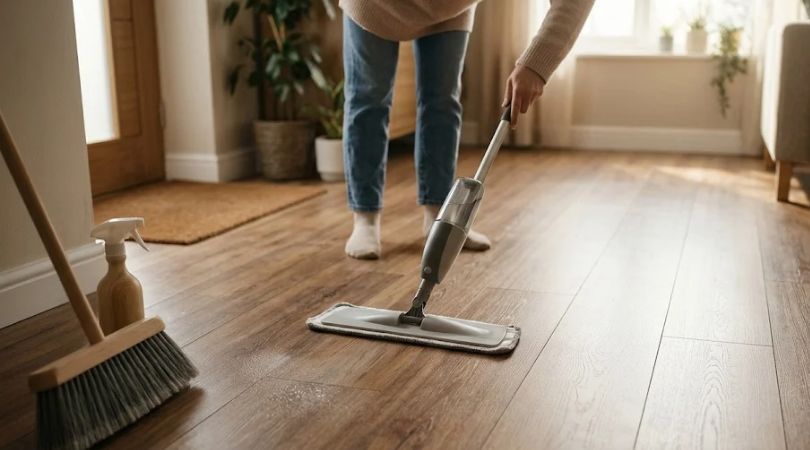
Clean laminate flooring by dust-mopping or vacuuming to remove grit, then wiping with a barely damp microfibre mop and a laminate-safe cleaner. The one rule that matters more than any other is damp, never wet: laminate has a wood-fibre core, and standing water seeps into the seams and swells the planks permanently. Keep water off it and laminate stays sharp for years.
Laminate’s One Real Weakness
Laminate is tough where you expect wear and fragile where you do not. The printed surface resists scratches, fading, and dents better than most floors, which is why it survives busy households and pets so well. Its weakness is water, and only water.
Under the hard printed wear layer sits a core of compressed wood fibre, and that core behaves like any wood product around moisture. Let water sit in a seam and the core drinks it up, then swells at the edges in a way that never flattens back out. That is why nearly every ruined laminate floor I see failed the same way, from wet mopping or a spill left to sit, not from traffic. Respect the water rule and the rest of laminate care is easy.
The Damp, Not Wet, Routine
The daily job is just grit control. Dust mop or vacuum with a soft-brush head, beater bar off, to lift the sand and winter salt that scratch any floor, focusing on the paths near Quebec entries where grit lands first.
For the weekly clean, wring a microfibre mop until it is barely moist and wipe with a laminate-safe cleaner, usually a light spray-and-mop product rather than a bucket. The floor should be dry seconds after you pass. If you can see a wet film or streaks drying behind you, the mop is too wet, and you are feeding the seams the one thing laminate cannot handle. A spray applicator beats a bucket precisely because it stops you overwetting.
Safe Cleaners And The Ones To Skip
| Use | Avoid | Reason |
|---|---|---|
| Laminate-specific spray cleaner | A wet string mop or bucket | Standing water swells the core at the seams. |
| Barely damp microfibre pad | Steam mop | Forces moisture and heat into the seams. |
| Plain water, lightly misted | Oil soap, wax, or polish | Leaves a dull, streaky film that laminate cannot absorb. |
| Soft-brush vacuum | Abrasive pads and scouring powder | Scratch the printed wear layer. |
| Felt pads and entry mats | Vinegar in strong concentration | Can dull the finish with repeated use. |
The products laminate owners misuse most are wax and polish, because they want to restore shine. Laminate has no finish to feed, so polish just sits on top as a streaky, dulling film that attracts dirt and is hard to remove. If a laminate floor looks dull, it is either filmed with residue, which a proper cleaner removes, or the wear layer has finally worn, which no product restores. Our how to clean hardwood floors guide covers the parallel rules for wood.
Also Read – Hardwood Floors vs. Laminate Floors: Making the Right Choice for Your Quebec Home
Removing Marks And Stains
Laminate’s hard surface actually makes spot-cleaning easy once you avoid water and abrasives. Wipe food and drink spills promptly with a damp cloth, then dry the spot, and most leave nothing behind.
For tougher marks, nail polish, tar, or crayon lift with a little acetone on a cloth, and chewing gum or candle wax harden with an ice pack and then scrape off with a plastic scraper, never a metal blade. Rubber heel scuffs usually erase with a dry cloth or a pencil eraser. The key through all of it is to apply the cleaner to the cloth, not to pour anything onto the floor, so no liquid finds a seam.
Stopping Edge Swelling And Peaking
Edge swelling is the failure to prevent, because it cannot be undone. It starts where water reaches a seam, from a wet mop, a dishwasher drip, a tracked-in puddle of melting snow, or a pet bowl, and the longer a laminate floor lives in a damp spot, the more the joints lift and the surface peaks.
Prevention is all about keeping those seams dry: wipe spills the moment they happen, put a tray under pet bowls and plants, lay a waterproof mat at every entry for Quebec slush, and in a kitchen or bathroom consider whether laminate is even the right floor, since luxury vinyl handles wet rooms far better. Peaking can also come from laminate installed too tight with no expansion gap, a reason to take installation seriously. The North American Laminate Flooring Association sets the performance and care standards the better brands build to.
Protecting High-traffic Zones And When Laminate Is Done
High-traffic lanes, the hall, the kitchen work triangle, the path from the door, wear first, so felt pads under furniture, a runner on the busiest lane, and a strict grit-control habit extend a laminate floor’s good years. A quality laminate with a high abrasion rating simply lasts longer under the same traffic.
“Laminate is the most forgiving floor in the house until the day someone wet-mops it,” says Sefi Dollinger, Owner of Planchers Bellefeuille, serving Quebec homeowners since 1983. “It takes the dog, the kids, the chairs, no problem. Then a bucket of water goes down the seams and the edges swell up and that is it, those planks are finished, because swollen laminate does not come back. Damp mop only, wipe spills now, keep a mat at the door for the slush, and laminate will look good far longer than people expect. When the wear layer finally goes, laminate cannot be refinished, so you replace it, which is still a straightforward job.”
Check Out – Laminate vs. Vinyl Flooring : Which One Actually Makes Sense for Your Space?
Frequently Asked Questions
Can you wet-mop laminate floors?
No. Laminate has a wood-fibre core, and standing water from a wet mop or bucket seeps into the seams and swells the planks permanently. Use a barely damp microfibre mop, ideally with a spray cleaner rather than a bucket, so the floor dries within seconds.
What is the best cleaner for laminate flooring?
A laminate-specific spray cleaner, or plain water lightly misted, applied with a well-wrung microfibre pad. Avoid oil soap, wax, and polish, which leave a streaky film laminate cannot absorb, and avoid strong vinegar solutions and abrasives, which dull or scratch the wear layer.
Why is my laminate floor swelling at the edges?
Water reached the seams. It comes from wet mopping, spills left to sit, melting snow tracked in, or a leak, and the wood-fibre core swells where it got wet and does not flatten back. Swelling can also come from laminate installed too tight with no expansion gap. Swollen planks have to be replaced.
Is a steam mop safe on laminate?
No. A steam mop forces moisture and heat straight into the seams, which is exactly what swells the core. Even though the surface feels waterproof, the seams are not, so steam mopping is one of the fastest ways to ruin a laminate floor.
Can laminate flooring be refinished when it wears out?
No. Laminate is a printed surface over a fibre core, so there is no solid wood to sand and refinish. When the wear layer finally wears through, the floor is replaced rather than refinished, which is one trade-off against solid hardwood.
Bring your laminate’s brand, or a spare plank, to the Saint-Jerome showroom and we will match you with a safe cleaner, and tell you honestly whether laminate or vinyl is the better fit for a wet room.