Walk into any flooring showroom in Quebec and you’ll find laminate and vinyl displayed side by side, looking nearly identical. Same plank format, same wood-grain visuals, similar price tags. At first glance, picking one over the other seems arbitrary.
It isn’t.
Once you understand what’s inside each of these products — and how they behave in the real conditions of a Quebec home — the decision becomes much clearer. Let’s walk through it properly.
Why People Confuse Them (And Why It Matters)
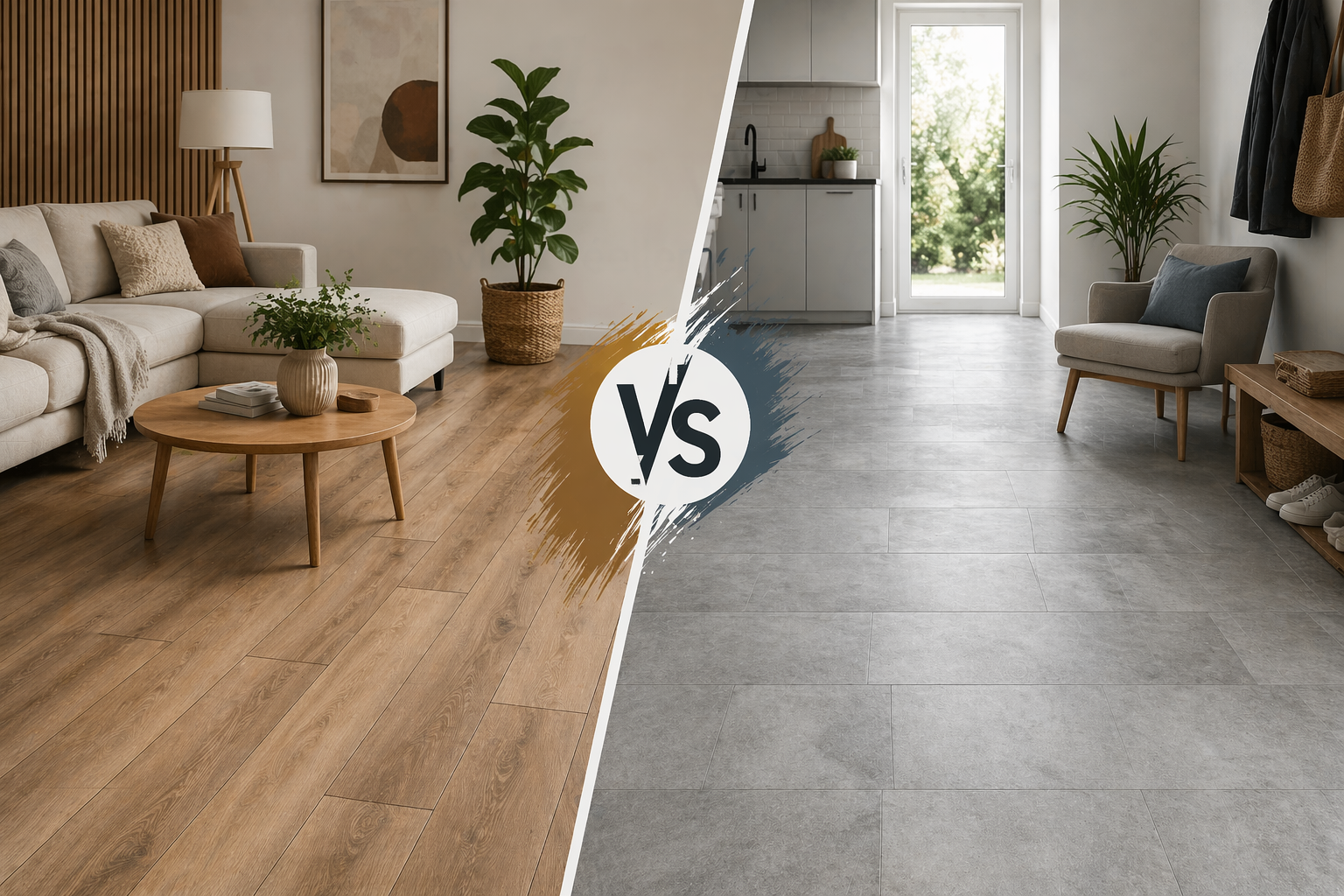
Laminate and vinyl both mimic the look of hardwood through a printed design layer. Both install with click-lock planks. Both are marketed as low-maintenance, budget-friendly alternatives to natural wood. From a design standpoint, a high-quality product from either category can be genuinely difficult to tell apart.
But the core construction is entirely different — and that difference determines where each product performs well and where it fails.
What’s Actually Inside
Laminate
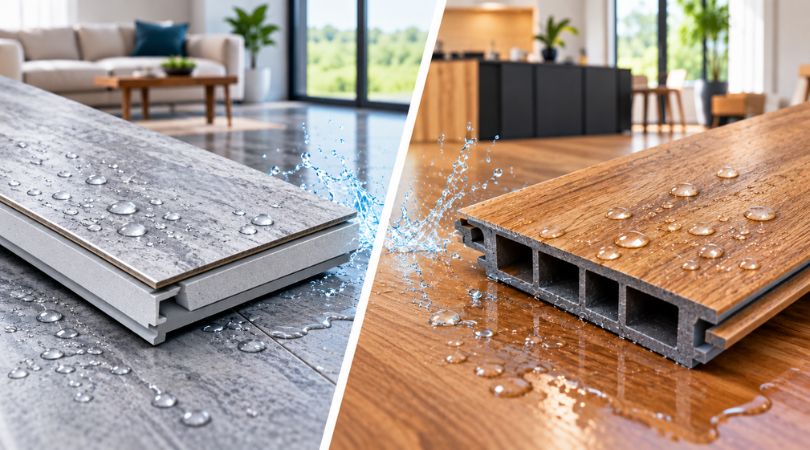
Laminate flooring is built on an HDF (high-density fiberboard) core — essentially compressed wood fibers, bonded under pressure. Above that core is a printed design layer, topped by a hard aluminum oxide wear coating. Below is a backing layer for stability.
The key thing to understand: that HDF core contains wood fiber. Wood fiber absorbs moisture. If water gets through the joints and into the core, laminate swells — and once it swells, it generally can’t be reversed. The damage is permanent.
Vinyl (LVP and SPC)
Modern vinyl flooring — sold as LVP (Luxury Vinyl Plank) or SPC (Stone Plastic Composite) — has no wood in it at all. The core is 100% synthetic: PVC, limestone, and plasticizer compounds, depending on the product type. Over that core is a printed design layer and a clear wear layer.
Because there’s no wood fiber anywhere in the product, vinyl is genuinely waterproof. It doesn’t swell when wet. It doesn’t absorb moisture. That’s the fundamental distinction.
| Feature | Laminate | Vinyl (LVP/SPC) |
| Core Material | HDF (compressed wood fiber) | PVC / Stone composite (no wood) |
| Water Resistance | Water-resistant; not waterproof | Fully waterproof |
| Scratch Resistance | Very high (aluminum oxide) | High (wear layer dependent) |
| Comfort Underfoot | Moderate | Moderate to soft (WPC) |
| Refinishable | No | No |
| Suitable for Basements | Waterproof products only | Yes (SPC recommended) |
| Price Range (approx.) | $3–$7/sq ft | $3–$8/sq ft |
Where Each Product Belongs in a Quebec Home
Laminate: The Better Choice for Dry Main-Level Spaces
Laminate’s real advantage is scratch resistance. The aluminum oxide wear coating is genuinely hard — harder than most vinyl products — which makes it a good choice for high-traffic areas where pets, furniture, and heavy foot traffic are a concern.
It also tends to feel slightly more solid underfoot than vinyl, which some homeowners prefer for main living areas and bedrooms.
Where laminate works well in Quebec homes:
- Main-level living rooms, dining rooms, and bedrooms
- Spaces with controlled indoor humidity
- Areas away from direct moisture exposure
- Homes where scratch resistance is the top priority
Where laminate struggles in Quebec:
- Entryways and mudrooms where snow, slush, and salt are tracked in
- Kitchens and bathrooms where spills are frequent
- Basements — unless the product is specifically rated waterproof throughout (not just surface-resistant)
“One of the most common mistakes we see is homeowners choosing laminate for areas exposed to moisture — entryways, basements, or kitchens. In Quebec, snow, slush, and humidity can get through joints quickly. Once that HDF core absorbs moisture, the floor is done. Vinyl is almost always the safer long-term investment for those spaces.”
— Sefi Dollinger, Owner, Planchers Bellefeuille | Planchers Bellefeuille, serving Quebec homeowners since 1983
Vinyl (LVP/SPC): The Better Choice for Moisture-Exposed Spaces
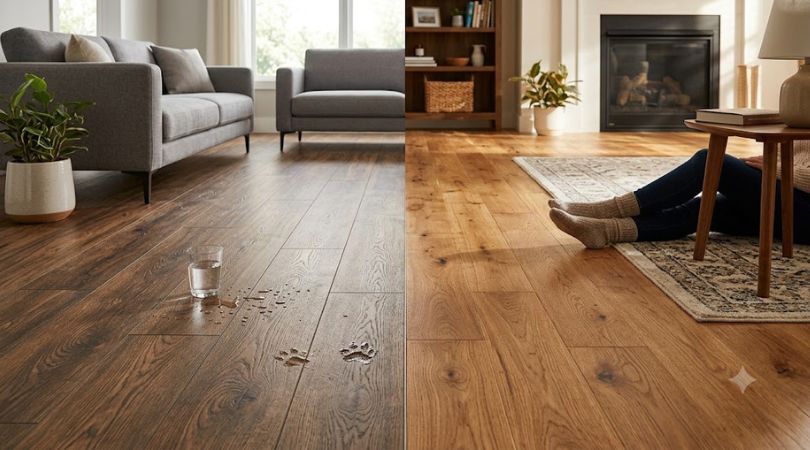
Vinyl’s defining strength is waterproof performance. Because the core contains no wood fiber, there’s nothing to absorb and swell. A spill left on vinyl overnight is an inconvenience. The same spill on laminate can permanently damage the floor.
SPC (Stone Plastic Composite) vinyl in particular has become the standard recommendation for Quebec basements and ground-level spaces because it adds dimensional stability to the waterproof core — it won’t flex or shift with temperature changes.
Where vinyl performs best in Quebec:
- Basements and below-grade spaces
- Entryways and mudrooms
- Kitchens and laundry rooms
- Bathrooms
- Any space with pets, children, or higher moisture exposure
A Note on TORLYS Products
At Planchers Bellefeuille, we carry TORLYS flooring — and it’s worth understanding what that means for this comparison. TORLYS manufactures both laminate and vinyl products, including their Smart Laminate line and their EverWood/EverTile SPC vinyl line.
Their Smart Laminate products use a sealed joint system that improves moisture resistance compared to standard laminate — which is why they perform better in higher-moisture areas than traditional laminate. However, even with sealed joints, laminate remains fundamentally different from vinyl at the core level. The right product still depends on the specific conditions of your space.
Our team can walk you through exactly which TORLYS product — or product from another manufacturer we carry — fits your specific floor and conditions.
The Durability Question
Both laminate and vinyl are durable products under the right conditions. The comparison that matters most is durability relative to the environment each product will live in.
Laminate’s aluminum oxide wear layer is extremely resistant to surface scratches — more so than most vinyl products at the same price point. If you have dogs with hard nails, heavy furniture that gets moved regularly, or kids who use the floor as a racetrack, laminate holds up exceptionally well on dry surfaces.
Vinyl’s wear layer is softer by comparison, but the product as a whole is far more resilient against the specific threats Quebec homes face: moisture infiltration, seasonal humidity swings, and the temperature fluctuations in below-grade spaces.
Sound, Feel, and Comfort
This is subjective, but worth mentioning. Laminate on a solid subfloor tends to feel slightly denser underfoot. Vinyl, particularly WPC products with a foamed core, can feel softer and quieter. For rooms where you spend a lot of time standing — kitchens, home offices — that cushioning can make a noticeable difference over time.
Both products benefit from a quality underlayment for sound absorption, particularly in multi-level homes or condos where sound transmission to lower floors matters.
Making the Right Call
The clearest way to frame this decision for Quebec homeowners:
- If your priority is scratch resistance and the space is dry: laminate is a strong choice.
- If your priority is moisture tolerance — or you’re installing anywhere near water: vinyl, particularly SPC, is the right call.
- For main-level living spaces with controlled conditions: either can work well; the tie-breaker is your specific lifestyle.
- For basements, entryways, kitchens, and bathrooms: vinyl is the professional recommendation.
The two products are close enough in price and appearance that it’s not worth compromising on the right fit for your conditions. Choosing laminate for a basement to save $1/sq ft, then replacing it in four years, isn’t a saving — it’s a cost.
Ready to Choose the Right Floor?
Not sure which is right for your specific space? Visit our Saint-Jérôme showroom or book a free consultation with our team.
We carry both laminate and vinyl products from TORLYS and other leading manufacturers — and we’ll give you an honest recommendation based on your floor, your lifestyle, and your budget.
📍 450, boul. Roland-Godard, Saint-Jérôme, QC | 📞 (450) 431-1643 | 🌐 planchersbellefeuille.com
Planchers Bellefeuille is an authorized TORLYS retailer and a family-owned flooring specialist serving the Saint-Jérôme region and greater Montréal area since 1983. A division of DZD Hardwood Inc.