Stock cabinets come in fixed sizes off a warehouse shelf, semi-custom cabinets offer limited size and finish changes within a catalogue, and custom cabinetry is built from scratch to your exact dimensions, materials, and layout. Custom costs more and takes longer, and it is worth it when your space is awkward, your standards are high, or stock sizes leave you with filler panels and wasted room.
The Question Behind The Question
When someone asks whether custom cabinets are worth it, they are really asking two things: will it fit my space better, and will it last longer. The honest answer is that it depends on your room and your priorities, and a good shop will tell you when stock is the smarter call.
So let us compare the three tiers plainly, then look at where each one actually wins. No shop that respects you should push custom into a square room with standard dimensions where stock would fit perfectly.
Stock, Semi-custom, And Custom Defined
| Factor | Stock | Semi-Custom | Custom |
|---|---|---|---|
| Sizing | Fixed increments, filler panels | Some size and depth options | Exact, wall-to-wall fit |
| Materials | Often particleboard boxes | Mixed options, plywood available | Your choice, including plywood and solid wood |
| Finish / Colour | Limited catalogue | Wider catalogue | Any species, stain, or paint |
| Lead Time | Fastest, often in stock | Moderate | Longest, built to order |
| Best For | Standard rooms and tight budgets | A middle-ground option | Awkward spaces, high standards, and longevity |
Stock cabinetry fills a standard room quickly and cheaply, and for a rental or a simple layout it does the job. The trade-off shows up at the edges, where fixed sizes rarely land on your wall dimensions, so you end up with filler strips and a few inches of dead cabinet you paid for but cannot use.
Fit, Materials, And Durability Compared
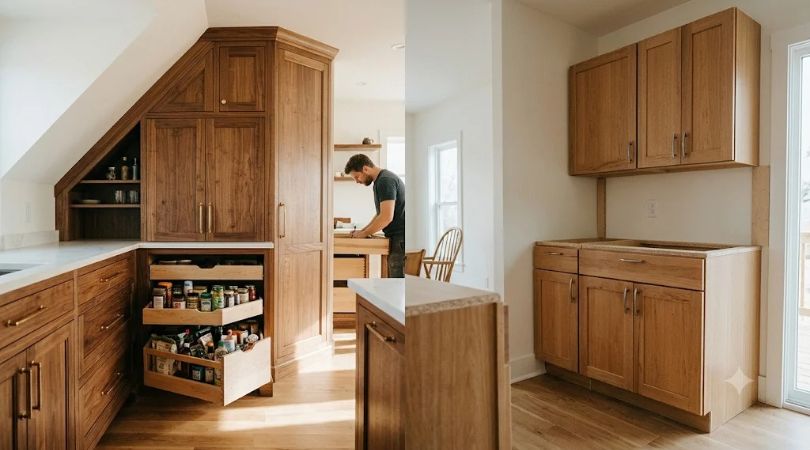
Fit is the first real difference. Custom cabinetry is measured to your walls, so it runs seamlessly into corners, under a sloped ceiling, or around the out-of-square walls common in older Quebec homes, with no fillers and no wasted space.
Materials are the second. Many stock lines use particleboard boxes that sag over time and swell permanently if they ever meet water, a real risk under a sink or in a humid basement. Custom work uses a plywood carcass and solid hardwood doors and face frames that stay flat, carry weight, and can be refinished years later. Look for the hallmarks of quality construction, dovetailed drawers, full-extension soft-close slides, and solid hinges, the same standards the KCMA cabinet certification program tests for. That hardware is where daily use is won or lost.
Design Freedom And Problem Spaces
Custom earns its keep where a catalogue runs out of answers. A tight galley, a peninsula that has to turn a corner cleanly, a bank of drawers sized to your pots, a pantry built into a chimney nook, these are the moments stock cabinets cannot solve without compromise.
It is also the only route to genuine material and style control. You pick the species, the door profile, the stain or paint, and the interior fittings, so the kitchen or vanity matches your hardwood floors and the rest of your custom millwork rather than approximating them. For a room where the cabinetry is the main event, that control is the whole point.
Lead Time And Cost, Honestly
Stock is fastest and cheapest, often available immediately, which matters when a project is on a deadline or a tight budget. Semi-custom sits in the middle on both. Custom takes the longest, because every piece is milled and finished to order, and it costs more for the materials, the labour, and the fit.
What the sticker price hides is the lifespan. A custom cabinet built from plywood and solid wood can be refinished and will outlast two sets of swollen particleboard, so over the life of a home the gap narrows. We walk clients through that math honestly, the same way our cabinetmaking page lays out what a bespoke project involves.
When Stock Is The Smart Call, And When Custom Wins
Choose stock when the room is a standard rectangle, the budget is tight, or the space is a rental or a quick flip where longevity is not the goal. There is no shame in stock cabinets that fit well and get installed next week.
Choose custom when the space is awkward, when you want materials and a finish that will last and can be refinished, or when the cabinetry is a feature you will look at every day for twenty years.
“I talk as many people out of custom as into it,” says Sefi Dollinger, Owner of Planchers Bellefeuille. “If your kitchen is a plain rectangle and your budget is tight, good stock cabinets installed properly will make you happy. Custom is for the room that fights you, the crooked wall, the odd corner, the pantry that has to tuck under the stairs, or the client who wants a kitchen that still looks sharp when the house sells. Pay for custom where it solves a real problem, not for its own sake.”
Frequently Asked Questions
Is custom cabinetry worth the extra cost?
It is when your space is awkward or your standards are high. Custom fits wall to wall with no filler panels, uses plywood and solid wood that last and can be refinished, and lets you control species, finish, and layout. In a plain, standard-sized room, good stock cabinets may serve you just as well for less.
What is the difference between semi-custom and custom cabinets?
Semi-custom cabinets offer limited size, depth, and finish changes within a manufacturer’s catalogue. Custom cabinets are built from scratch to your exact dimensions and specifications, with any species, finish, and interior fitting you want, which is why they cost more and take longer.
Are stock cabinets lower quality?
Not always, but many stock lines use particleboard boxes that sag over time and swell if they meet water. The better signals of quality at any tier are a plywood carcass, solid wood doors, dovetailed drawers, and soft-close hardware. Check the construction, not just the price.
How much longer does custom cabinetry take?
Stock is often available immediately, while custom is milled and finished to order, so it takes the longest of the three tiers. Start the design and measure early in your renovation so the cabinetry is ready when the room is, and so it can be coordinated with your floors and millwork.
Can custom cabinets match my existing floors and trim?
Yes, that is one of the main reasons to choose custom. You select the species, stain or paint, and sheen, so the cabinetry coordinates with your hardwood and other millwork instead of only approximating them.
Bring your kitchen or vanity measurements to the Saint-Jerome showroom and we will give you a straight answer on whether custom is worth it for your space, or whether stock will serve you just as well.