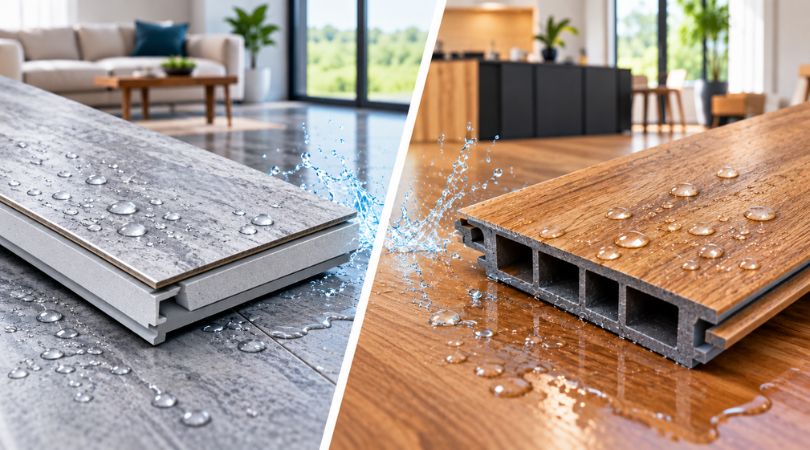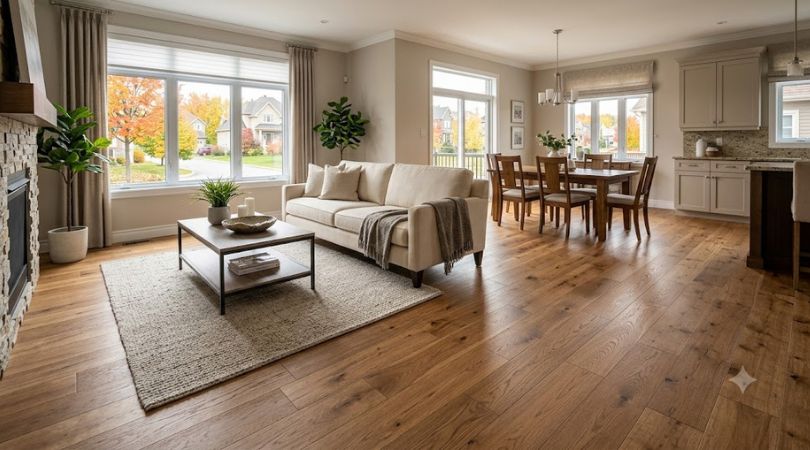
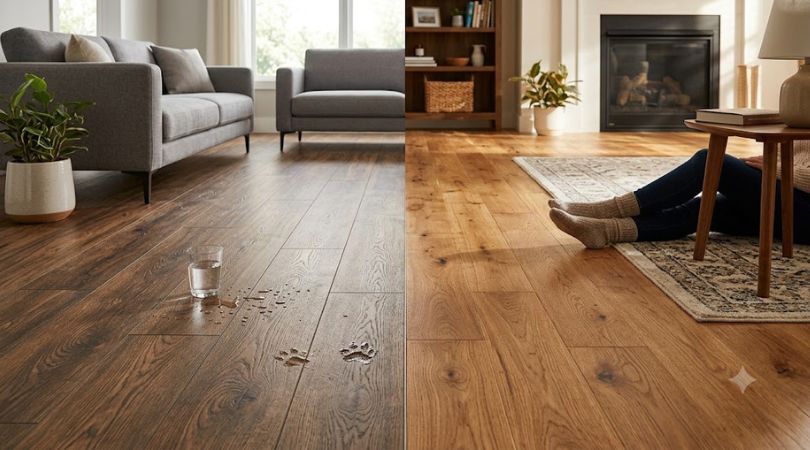
Wood-look porcelain is tile printed and textured to imitate hardwood, and today’s versions are convincing from a standing height. Choose porcelain where water and wear are extreme, like bathrooms, entries, and mudrooms, because it is fully waterproof and nearly indestructible. Choose real hardwood in living spaces where warmth, comfort, and resale value matter, because nothing feels or sells like the real thing. Many Quebec homes use both.
The Imitation Got Good, But It Is Still An Imitation
A decade ago, wood-look tile fooled no one. The planks were short, the grain repeated, and the surface felt like tile pretending to be wood. High-resolution printing and better texturing changed that, and a good wood-look porcelain now reads as hardwood from across a room. Up close and underfoot, though, the difference remains. Porcelain is hard, cool, and unyielding, while wood is warm, gives slightly, and sounds different when you walk on it. Neither is better in every way. Porcelain trades warmth and comfort for being waterproof and almost impossible to damage. Wood trades some durability and water resistance for the feel, the warmth, and the resale value only real hardwood carries. The smart approach is not to declare a winner, but to put each material where its strengths matter most, which in a Quebec home often means using both.
Head To Head On What Matters
- Water resistance: porcelain is fully waterproof, hardwood is not.
- Durability: porcelain is nearly indestructible and scratch-proof, hardwood is good but can scratch and dent.
- Warmth underfoot: porcelain is cool and hard, hardwood is warm with slight give.
- Refinishing: porcelain cannot be refinished but rarely needs it, hardwood can be sanded and refinished over decades.
- Radiant heat: porcelain is an excellent conductor, hardwood is good if engineered and rated.
- Resale appeal: porcelain is good, hardwood is strongest because buyers pay for real wood.
- Repair: porcelain means replacing a tile, hardwood means sanding out or replacing boards. Porcelain wins on water and toughness. Wood wins on warmth and value. That split is the whole decision.
Where Porcelain Is The Clear Winner
Some rooms punish a wood floor no matter how careful you are, and that is exactly where wood-look porcelain shines. It gives you the wood look in the places wood should not go. Put porcelain in the bathroom, where standing water and splashes would threaten any wood floor, and the wood look flows in without the risk. Put it in the entry and mudroom, where Quebec winters deliver road salt, slush, and wet boots for months, because porcelain shrugs off all of it and cleans up with a mop. It is also the best partner for radiant heat, since tile conducts warmth beautifully and never minds the temperature swings. In these zones, porcelain is not a compromise, it is the better floor, and it can carry the same wood tone as the hardwood in the next room.
Where Real Hardwood Is Worth It
In the rooms you live in and relax in, the qualities porcelain cannot copy start to matter, and real wood earns its place. This is about how a floor feels, not just how it looks. In the living room, bedrooms, and main-floor spaces, hardwood’s warmth and slight give make the room more comfortable to stand and walk on, especially barefoot on a winter morning, and that comfort is something a hard tile cannot match. Hardwood is also refinishable, so a floor that looks tired after twenty years can be sanded back to new rather than replaced. And it carries resale weight, because buyers recognize and pay for genuine hardwood in a way they do not for tile, however convincing.
Also Read – Oak, Maple, Hickory, or Birch? A Complete Guide to Hardwood Species for Quebec Homes
The Warmth And Comfort Gap
The single biggest everyday difference between these floors is how they feel on a cold Quebec morning. Porcelain is a hard, cool surface that conducts heat away from your feet, so without radiant heat beneath it, tile feels cold, and it stays firm and unforgiving underfoot all day. Hardwood is naturally warmer to the touch and has a slight give, so it feels comfortable barefoot and easier on your legs during long stretches of standing. This is why so many Quebec homeowners love porcelain in the entry and bath but want wood underfoot in the living room. Radiant heat closes the warmth gap by warming the tile directly, and it is the reason wood-look porcelain over in-floor heating is such a popular combination here. If you choose porcelain in a room without radiant heat, plan for area rugs and know it will feel cool in January.
Why I Usually Recommend Both?
“Customers come in thinking they have to pick one, wood or wood-look tile, and I almost always tell them to use both,” says Sefi Dollinger, Owner of Planchers Bellefeuille, serving Quebec homeowners since 1983. “Put the porcelain where water and boots live, the bathroom, the front entry, the mudroom, and put real hardwood where you relax. We can match the tones so the transition looks intentional, not like two different floors slammed together. You get a waterproof floor exactly where you need it and a warm, real wood floor where it counts. That is not a compromise, that is using each material for what it does best.”
Frequently Asked Questions
1. Is wood-look porcelain as good as real hardwood?
It depends on the room. Wood-look porcelain is better where water and wear are extreme, like bathrooms and entries, because it is fully waterproof and nearly indestructible. Real hardwood is better in living spaces, because it is warmer and more comfortable underfoot, can be refinished, and carries stronger resale value. Each wins in different rooms.
2. Can you tell the difference between wood-look tile and hardwood?
From a standing height, a good wood-look porcelain is convincing and hard to distinguish from hardwood. Up close and underfoot, the difference is clear: porcelain is hard, cool, and unyielding, while wood is warm, gives slightly, and sounds different when you walk on it. The look can fool the eye, but the feel gives it away.
3. Which is better for a bathroom, porcelain or hardwood?
Wood-look porcelain is better for a bathroom because it is fully waterproof and handles standing water and splashes that would damage any wood floor, while giving you the wood look. Real hardwood, even engineered, carries water risk in a bathroom. Porcelain also pairs well with radiant heat to warm the naturally cool tile.
4. Does wood-look tile add resale value?
Wood-look porcelain adds solid resale value and is well regarded, but real hardwood carries the strongest appeal, because buyers recognize and pay a premium for genuine wood. A common high-value approach is porcelain in wet areas and real hardwood in the main living spaces, which gives buyers both durability and the wood they want.
5. Is porcelain tile cold underfoot?
Yes. Porcelain is a hard surface that conducts heat away from your feet, so without radiant heat beneath it, tile feels cool, especially in a Quebec winter. Radiant heating warms the tile directly and solves this, which is why wood-look porcelain over in-floor heat is popular here. Area rugs help in rooms without radiant heat.
6. Can wood-look porcelain go over radiant heating?
Yes, and it is one of the best floors for radiant heat. Porcelain conducts warmth efficiently and never minds the temperature swings of in-floor heating, so it warms evenly and stays stable. This combination gives you a waterproof, wood-look floor that also feels warm underfoot, ideal for a Quebec bathroom, entry, or kitchen.
7. Which lasts longer, porcelain or hardwood?
Porcelain lasts longer as a surface because it is scratch-proof, waterproof, and nearly indestructible, though it cannot be refinished and a damaged tile is replaced rather than repaired. Hardwood can last decades and be sanded and refinished multiple times, so it renews rather than replaces. Both are long-lived when installed and cared for properly.
8. Can I mix wood-look tile and hardwood in the same home?
Yes, and it is a smart approach many Quebec homeowners use. Put porcelain in wet, high-traffic zones like bathrooms, entries, and mudrooms, and real hardwood in living rooms and bedrooms, matching the tones so the transition looks intentional. This puts each material where its strengths matter most and avoids the weaknesses of using only one.
Compare a wood-look porcelain against real hardwood side by side in our Saint-Jerome showroom, and we will help you plan which floor goes in which room.
450, boul. Roland-Godard, Saint-Jerome, QC | (450) 431-8789 | planchersbellefeuille.com