The right hardwood species depends on how much wear the floor takes, the light in the room, and the look you want. For most Quebec homes, white oak is the safe all-rounder, hickory is the toughest, hard maple suits clean modern rooms, and yellow birch is the warm local classic. Species changes durability, colour, and price more than any finish ever will.
Start With The Janka Scale
Before you fall for a colour, look at the number behind it. The Janka hardness test measures the force needed to embed a small steel ball halfway into a board. A higher number means the wood resists dents and scratches better. The National Wood Flooring Association uses it as the industry reference, and so do I when a client has big dogs or three kids under ten.
Hardness is not everything. A hard floor still scratches if the finish is thin, and a softer wood can stay pristine for decades in a quiet room. But the Janka number tells you how much daily life a species absorbs before it shows. Read it as the floor’s tolerance for everyday living, then weigh it against the room.
White Oak: The Durable All-rounder
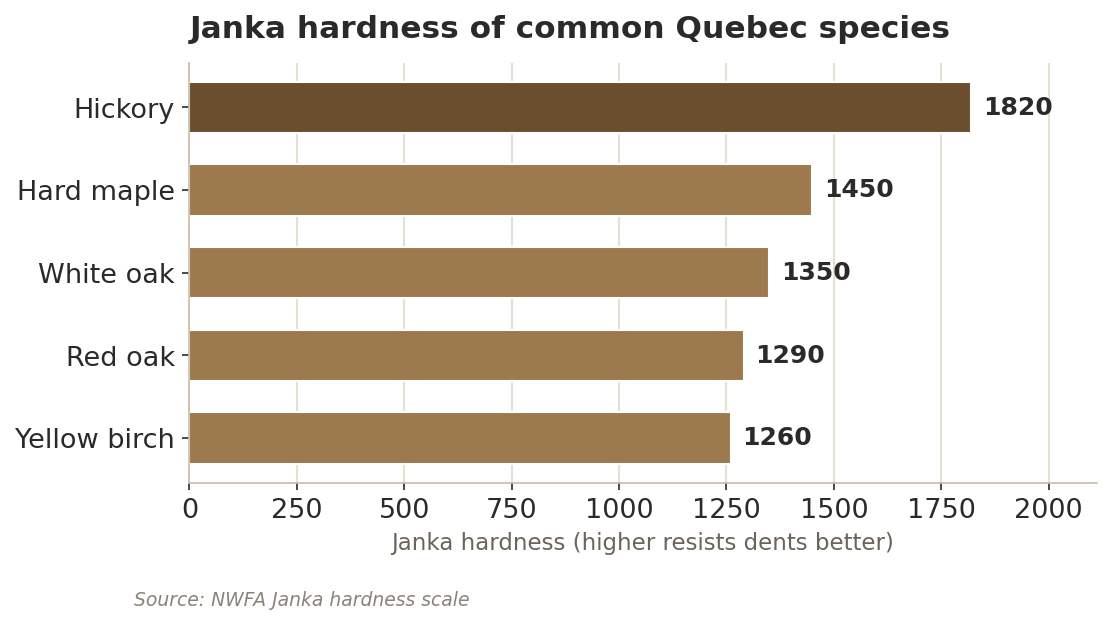
White oak is the species I recommend most, for good reason. At roughly 1,350 on the Janka scale, it takes normal family wear, its tight grain hides small scratches, and its cool grey-brown tone works with almost any cabinet or wall colour. It also takes stain evenly, so you can go pale Scandinavian or dramatic dark from the same board.
For a Quebec home moving from a humid August to a very dry January, white oak is also stable and predictable. Its closed grain makes it more water-resistant than red oak, which is why it is the standard choice for kitchens and entries. This is the wood I would put in my own living room without hesitating.
Red Oak: Warm Tone And Strong Value
Red oak is white oak’s more affordable cousin. It is slightly softer at around 1,290 Janka, with a pink to amber undertone and a bolder, more open grain. That prominent grain is either the look you love or the one you do not, so see a large sample before deciding.
Red oak’s value is real. It is often the best cost per square foot in solid hardwood, and it refinishes beautifully. For a busy family room on a budget, it holds up well and ages with character. Its open grain also camouflages dents better than a smooth species, which matters more than people expect.
Hard Maple: Hardness And Clean Grain
Hard maple runs above 1,450 Janka, harder than either oak, with a smooth subtle grain and a bright cream colour. It is the species used for bowling lanes and basketball courts, which tells you plenty about its resistance. In a house, it reads clean and contemporary.
One caution: maple’s tight pores resist stain, so dark colours can blotch unevenly. It is at its best left natural or in a pale tone. If you want a pale, modern, seamless-looking floor that takes punishment, maple earns its place. Ask specifically for a reputable prefinished maple, because site-staining maple is where most disappointments happen.
Hickory: Maximum Durability And Character
Hickory is the toughest common flooring species at close to 1,820 Janka, and it has the look to match. Wide colour swings, from blonde sapwood to chocolate heartwood within the same board, give it a rustic-modern character that either anchors a room or overwhelms a small one.
I steer families with big active dogs toward hickory more than any other wood. It takes claws, boots, and dropped toys without flinching. In an open-plan main floor with heavy traffic, few floors last longer. The tradeoff is that its dramatic variation makes it a poor match for a minimal, uniform aesthetic.
Yellow Birch: The Quebec Classic
Yellow birch is the local hero, harvested across Quebec and used in Quebec homes for generations. At about 1,260 Janka, it sits near red oak for hardness, with a fine, gently flowing grain and a soft golden tone that warms a room in winter light.
There is a reason so many older Quebec homes have birch floors that still look good. It is a regional wood suited to our climate, often with a shorter supply chain than exotic imports. For anyone who wants a genuinely Quebec floor, birch is a proud choice, and availability is usually excellent.
Ash, Walnut, Cherry, And Beech
Beyond the big five, four more species come up regularly in the showroom.
Ash sits around 1,320 Janka, close to white oak, with a bold straight grain and a pale, slightly blonde tone. It is a good alternative when white oak lead times stretch, and it takes stain well. Ash supply has become less predictable because of the emerald ash borer, so confirm availability early.
Black walnut is the luxury choice at roughly 1,010 Janka. It is genuinely soft for a hardwood, which surprises people who assume expensive means durable. What you get is an unmatched deep chocolate colour with purple undertones that no stain replicates on another species. Walnut belongs in a formal living room or a primary bedroom, not a mudroom with a labrador.
American cherry is softer still at about 950 Janka, and it famously darkens with light exposure, deepening from pale pink to a rich reddish brown over a few years. That patina is the point, but it means area rugs left in place create permanent light patches. Beautiful and demanding.
Beech is hard at around 1,300 Janka but noticeably less dimensionally stable than oak, meaning it moves more with humidity swings. In a Quebec climate with a wide seasonal humidity range, I rarely recommend it for solid installations.
Hardwood Grades: Select, Character, And Rustic
Grade is not quality. This confuses almost everyone. Grade describes how much natural variation, knotting, and colour change the boards contain, not how well the floor is made. A rustic grade floor from a good mill outperforms a select grade floor from a bad one.
Select (sometimes called Clear or Prime) has minimal knots, tight colour consistency, and long boards. It reads formal and calm, and it costs the most because fewer boards from each log qualify.
Character (also called Natural or #1 Common) allows small knots, mineral streaks, and visible colour variation. This is the sweet spot for most homes, both in price and in appearance, and it hides life better than select.
Rustic (#2 Common or Cabin) includes larger knots, open checks, and strong colour swings. It suits a country or chalet aesthetic and is the least expensive. It also camouflages wear better than any other grade, which is a genuine practical advantage in a busy house.
A practical note: a lower grade means more waste, so order 10 to 15 percent overage on rustic rather than the usual 7 to 10 percent.
SOLID Versus Engineered, By Species
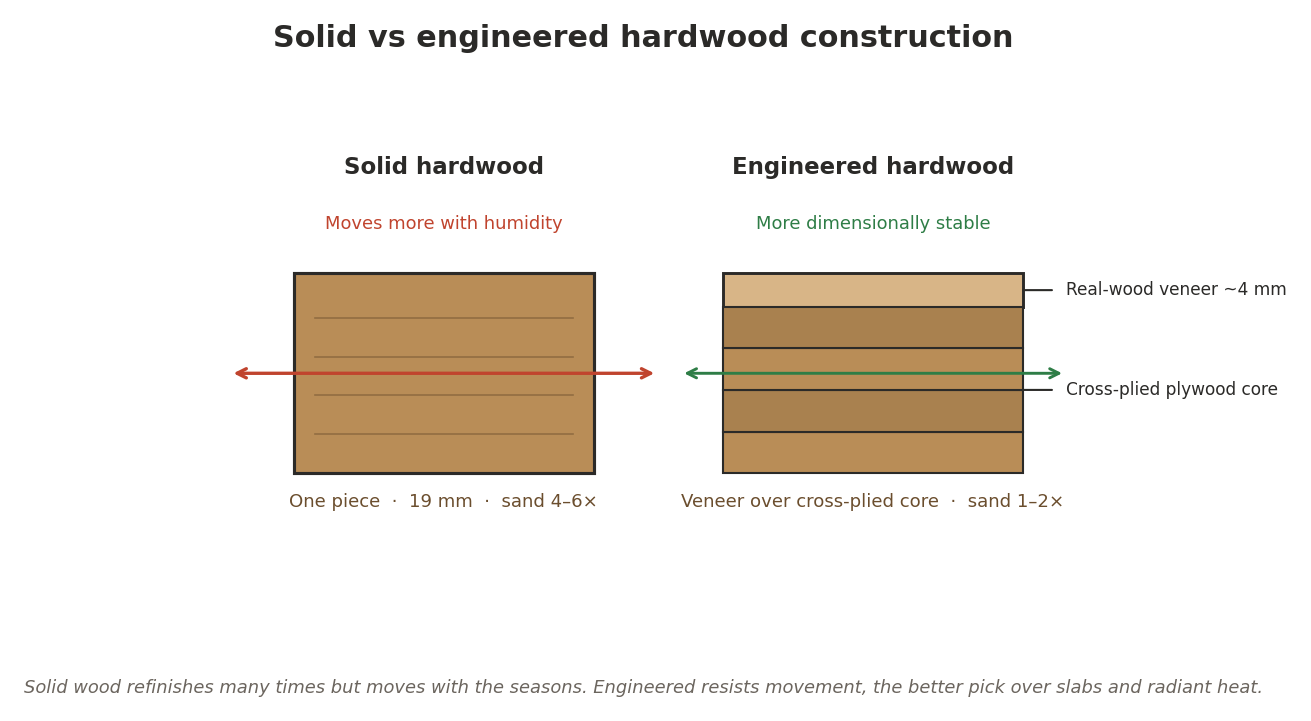
Species choice interacts with construction. Solid hardwood is one piece of wood, typically 19 mm thick, and it can be refinished many times. Engineered hardwood is a real wood veneer over a plywood or HDF core, which makes it far more dimensionally stable.
In a Quebec home, the deciding factors are the subfloor and the humidity swing. Over a concrete slab, in a basement, or over radiant heat, engineered is the correct answer and solid is a mistake. Over a wood subfloor above grade, either works.
Species matters here because the less stable species benefit most from engineered construction. Beech, hickory, and maple all move more than white oak, so an engineered version of those species solves a real problem. Our engineered hardwood page covers the constructions we carry, and our solid versus engineered comparison frames the wider choice.
Climate Performance And Seasonal Movement
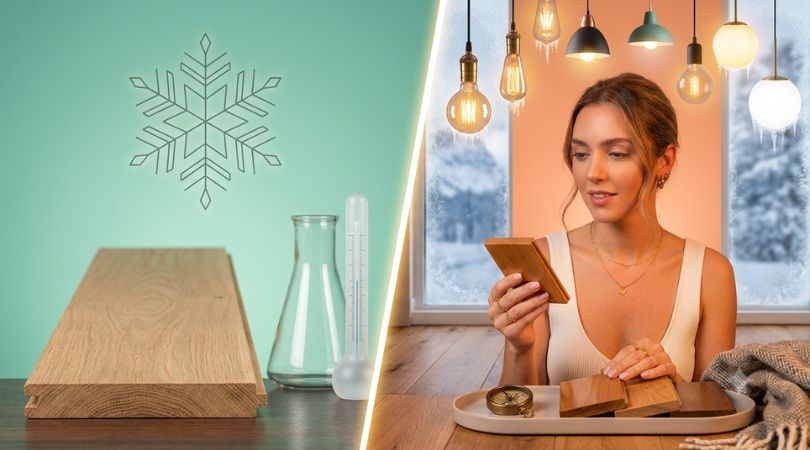
This is the part most species guides skip, and in Quebec it matters more than anywhere. Wood is hygroscopic, meaning it absorbs and releases moisture with the surrounding air. Our indoor humidity can swing from above 55 percent in August to below 25 percent in February once the furnace has run for a few months.
That swing makes boards shrink in winter and expand in summer. Thin gaps appearing between boards in January are normal seasonal behaviour, not a defect, and they usually close by June. What is not normal is permanent cupping, crowning, or splitting, which points to a real moisture problem.
Species differ in how much they move. White oak and yellow birch are comparatively stable. Hickory, maple, and beech move more, so in a wide plank they are more likely to show winter gapping. Plank width amplifies everything: a 190 mm board moves roughly twice as much as a 95 mm board of the same species.
The fix is humidity control, not species avoidance. Keep the house between 35 and 55 percent relative humidity year round with a humidifier in winter and an HRV or dehumidifier in summer, and keep a hygrometer in the main living space. Our cold climate flooring guide goes deeper on managing this.
Species Compared, Everything That Matters
| Species | Janka | Colour and Grain | Cost | Stability | Refinishing Potential | Maintenance | Best Suited To |
|---|---|---|---|---|---|---|---|
| White oak | ~1,350 | Cool brown, tight grain, stains evenly | Mid to high | Very good | Excellent | Low | Almost any room, the safe pick |
| Red oak | ~1,290 | Warm pink-amber, open grain | Low to mid | Very good | Excellent | Low | Budget family rooms, refinishing projects |
| Hard maple | ~1,450 | Cream, smooth, subtle grain | Mid to high | Moderate | Good | Low | Clean modern rooms, natural finishes |
| Hickory | ~1,820 | High contrast, rustic | Mid to high | Moderate | Good | Low | Big dogs, busy main floors, chalets |
| Yellow birch | ~1,260 | Golden, fine grain, local | Low to mid | Good | Good | Low | Traditional Quebec homes, warm interiors |
| Ash | ~1,320 | Pale blonde, bold straight grain | Mid | Good | Excellent | Low | White oak alternative, light interiors |
| Black walnut | ~1,010 | Deep chocolate, purple undertone | High | Good | Moderate, thin wear | Higher | Formal rooms, primary bedrooms |
| American cherry | ~950 | Pink darkening to red-brown | High | Good | Moderate | Higher | Low-traffic formal spaces |
| Beech | ~1,300 | Pale, uniform, fine | Mid | Poor for solid | Good | Moderate | Engineered only in our climate |
Choosing By How You Actually Live
The numbers only matter once you place them in a real room and a real household.
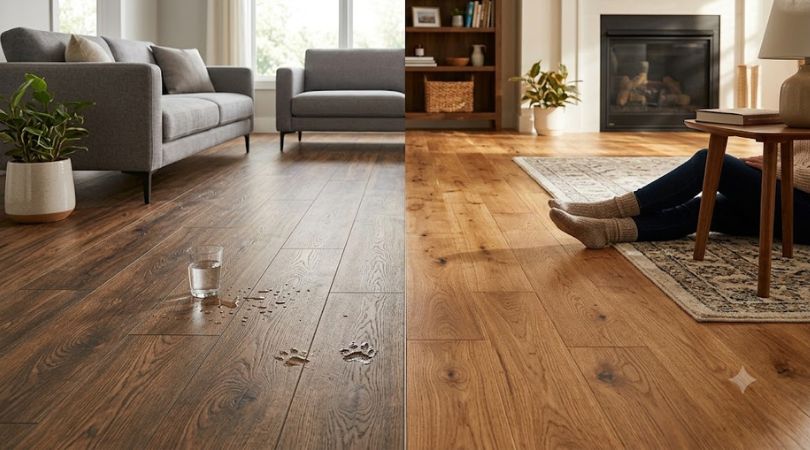
Best for pets. Hickory first, then hard maple and white oak. Skip walnut and cherry entirely with a large dog. Pair any of them with a factory-cured aluminum oxide finish in a matte sheen, and see our luxury vinyl range if durability outranks having real wood.
Best for kitchens. White oak, because its closed grain resists water better than red oak’s open grain. Keep a mat at the sink regardless. If the kitchen is the heart of a busy house, consider engineered white oak over solid.
Best for children. Hickory or red oak in a character or rustic grade. The logic is camouflage as much as hardness. A busy grade with natural variation hides the scooter marks that a select grade white oak would broadcast.
Best for modern and minimal homes. Hard maple or white oak in a select grade, wide plank, matte natural finish. Consistency is the aesthetic, so pay for the grade.
Best for traditional Quebec homes. Yellow birch, in a narrower plank, which matches the proportion of older houses and the regional building tradition.
Best on a budget. Red oak, character grade, in a standard width. It is the best durability per dollar in the category and it refinishes as well as anything.
Three Choices From The Showroom Floor
A family in Blainville with two labradors came in set on wide plank walnut they had seen online. We put a walnut sample and a hickory sample on the counter and pressed a key into both. The walnut marked, the hickory did not. They went hickory in a character grade and have never mentioned the floor since, which is the goal.
A couple renovating a 1940s Saint-Jerome duplex wanted to keep the building’s period feel. Yellow birch in a 95 mm width matched what was already in the upstairs unit, kept the proportions right, and cost less than the white oak they had been quoted elsewhere.
A young family furnishing a new build wanted pale and modern but had a three-year-old. Select grade maple would have shown every mark. We moved them to white oak in a character grade with a matte finish, which reads almost as light and hides ten times more.
Cost, Availability, And The Last Word
Price roughly tracks hardness and grade, with red oak and birch on the affordable side and wide-plank white oak, hickory, and walnut costing more. Availability moves too, so ask what is actually in stock before you fall in love with a look. Lead times on specific grades and widths can run several weeks.
“People pick a colour and think they are done,” says Sefi Dollinger, Owner of Planchers Bellefeuille, serving Quebec homeowners since 1983. “But the species under that colour decides whether the floor still looks right in fifteen years. I have seen a soft wood in an entryway wear through to bare wood, and a hickory floor next door take everything a family threw at it. Choose the wood for the room and the life happening in it, then choose the colour.”
For the species we stock and can order, see our hardwood flooring page, and browse the full flooring range if you are still weighing materials.
Frequently Asked Questions
What is the hardest wood flooring species?
Among common flooring species, hickory is the hardest at roughly 1,820 Janka. Some exotic imports rate higher, but hickory is the toughest widely available domestic option and it is well suited to the Quebec climate.
Is oak or maple better for flooring?
White oak is more versatile because it stains evenly and is more dimensionally stable. Hard maple is harder and reads cleaner and more modern, but it blotches with dark stains. For most homes, white oak is the safer choice.
What is the difference between white oak and red oak?
White oak is slightly harder, has a cooler grey-brown tone, and has a closed grain that resists water better. Red oak is pinker, has a more open and prominent grain, and costs less. Both refinish extremely well.
Which hardwood is best for Quebec winters?
White oak and yellow birch, because both are dimensionally stable through a wide humidity swing. More important than species is keeping indoor humidity between 35 and 55 percent year round.
Are gaps between boards in winter normal?
Yes. Wood shrinks as indoor air dries out during heating season, so thin seasonal gaps appear in January and generally close by summer. Permanent cupping, crowning, or splitting is a different problem and needs inspection.
What hardwood grade should I choose?
Character grade suits most homes. It costs less than select, hides wear better, and still looks refined. Choose select for a formal minimal look, and rustic for a chalet aesthetic or maximum camouflage.
Does grade affect durability?
No. Grade describes appearance and natural variation, not structural quality or hardness. A rustic grade board is exactly as hard as a select board of the same species.
Can I put solid hardwood in my basement?
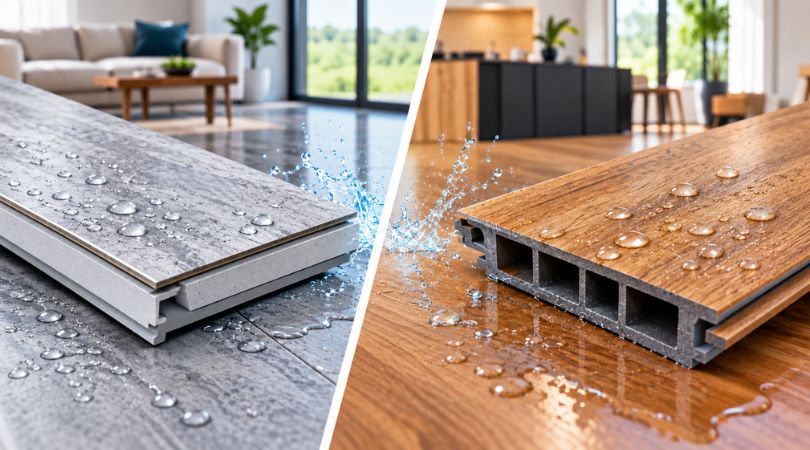
No. Basements sit on or below grade over concrete, which carries moisture, and solid wood will cup or buckle. Engineered hardwood or a waterproof product is the correct choice there.
What is the best hardwood for wide plank floors?
White oak. It is stable enough to handle the extra width without excessive seasonal movement. Wider boards of less stable species like maple or hickory show winter gapping more.
How many times can hardwood be refinished?
Solid hardwood typically allows four to six sandings across its life, since only the roughly 6 mm above the tongue is usable. Engineered depends entirely on veneer thickness, with 4 mm or more allowing one or two light sandings.
Is walnut flooring durable enough for a family home?
Walnut is soft for a hardwood at about 1,010 Janka. It suits low-traffic formal rooms and bedrooms. In a busy family space with pets or young children, it will show wear quickly.
Which species is most sustainable?
Locally harvested yellow birch, because Quebec supply means a short transport chain and regionally managed forests. Ask for FSC certification if third-party verification matters to you.
Visit our Saint-Jerome showroom or book a consultation.
450, boul. Roland-Godard, Saint-Jerome, QC | (450) 431-8789 | planchersbellefeuille.com