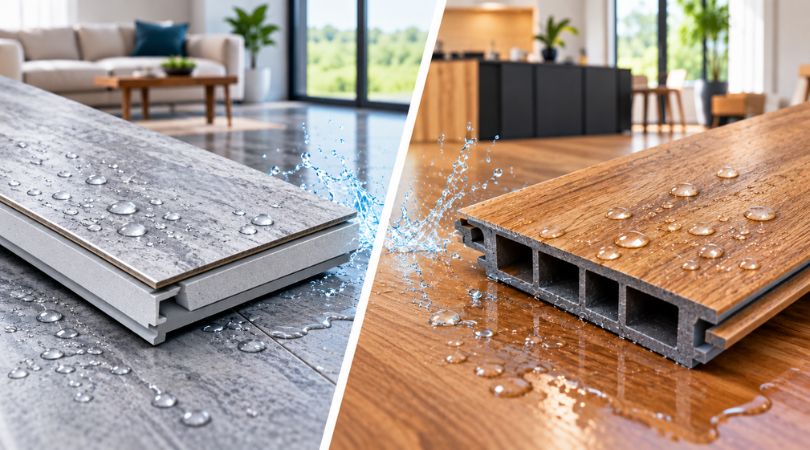
SPC and WPC are both waterproof rigid-core vinyl floors, and the difference is the core. SPC has a dense stone-plastic core that is harder, thinner, and more dent-resistant. WPC has a foamed wood-plastic core that is softer, warmer, and more comfortable underfoot. For most Quebec homes, SPC wins on durability, while WPC wins on comfort. The right pick depends on the room.
Rigid-core Vinyl Solved The Old Vinyl Problem
Vinyl used to mean thin, flexible sheets that telegraphed every bump in the subfloor and dented under a chair leg. Rigid core changed that completely. Both SPC and WPC are built as a solid, dimensionally stable plank that clicks together and floats over your subfloor without glue. Because the core is rigid and waterproof, these floors do not swell in water, do not curl at the edges, and hide minor subfloor imperfections instead of showing them. That is why rigid-core vinyl has taken over kitchens, bathrooms, basements, and busy family spaces. The remaining question is which core you want under your feet, because SPC and WPC feel and behave differently even though both are marketed as luxury vinyl. Get that choice right and the floor disappears into the background, exactly where a good floor belongs.
The Core Difference, Side By Side
The letters tell the story. SPC is Stone Plastic Composite, WPC is Wood Plastic Composite. Core density: SPC is dense and hard, WPC is foamed and softer. Dent resistance: SPC excellent, WPC good. Comfort underfoot: SPC firm, WPC cushioned and warmer. Sound underfoot: SPC can be louder (add underlay), WPC quieter and warmer. Plank thickness: SPC thinner, WPC thicker. Best rooms: SPC for kitchens, entries, and high traffic; WPC for bedrooms, living rooms, and basements. Relative cost: SPC lower to mid, WPC mid to higher. Neither is fragile. Both are fully waterproof. You are trading a little comfort for a little toughness, or the other way around, depending on which core you pick.
Which Core Suits Which Room
Match the core to what the room demands and the decision makes itself. Put SPC where life is hardest: kitchens with dropped pots, entryways that meet winter boots, hallways, and any high-traffic path. Its dense stone core shrugs off dents and heavy furniture, and its thinner profile transitions cleanly to other floors. Put WPC where comfort matters most: bedrooms, living rooms, and family rooms where you walk barefoot and want a little give and warmth underfoot. Its foamed core is quieter and feels softer, which is why it suits the rooms you relax in. In a basement, either works because both are waterproof, though WPC’s warmth is a real plus over a cold slab.
The Cold-floor Factor Most Guides Skip
In Quebec, how a floor feels on a January morning is a real consideration, and this is where WPC has a quiet edge. A denser SPC core conducts cold a little more readily and feels firmer and cooler underfoot, especially over a basement slab. WPC’s foamed core holds a touch more warmth and gives slightly, so bare feet notice the difference on a cold morning. Neither floor is actually cold the way tile is, and both pair beautifully with radiant heating, which erases the question entirely. If you are putting rigid vinyl over an unheated slab and comfort matters, WPC or an SPC with an attached comfort backing is the kinder choice. If you have radiant heat below, choose on durability instead, because the warmth is already handled.
Also Read – Flooring for Cottages and Chalets: What Works in Seasonal and Unheated Homes
Read The Wear Layer, Not Just The Label
Here is the number that actually predicts how long your floor lasts, and it applies to both SPC and WPC. The wear layer is the clear protective top coat, measured in mils, and it matters more than the core type for everyday durability. A 6 to 8 mil wear layer suits a light-traffic bedroom. A 12 mil layer handles a normal household. For a busy family kitchen, a mudroom, or a home with dogs, insist on 20 mil or more. I have watched two floors from the same showroom age completely differently because one buyer chose a thin wear layer to save a few dollars. Also check for a real VOC certification like FloorScore, which the Resilient Floor Covering Institute administers, so you know the floor is safe for indoor air. Core type sets the feel, but the wear layer and the certification set the lifespan and the air quality.
What I Recommend In The Showroom?
“People walk in asking for SPC or WPC by name because they read a blog, and then they cannot tell the samples apart with their eyes,” says Sefi Dollinger, Owner of Planchers Bellefeuille. “So I make them close their eyes and stand on both. SPC feels solid and tough, WPC feels a little softer and warmer. That is the whole choice. I put SPC in my kitchen because I drop things, and I would put WPC in a bedroom because I walk there barefoot. Then I make everyone check the wear layer, because that is the number that decides how the floor looks in ten years.”
Frequently Asked Questions
1. What is the difference between SPC and WPC vinyl flooring?
SPC has a dense stone-plastic core that is harder, thinner, and more dent-resistant, while WPC has a foamed wood-plastic core that is softer, warmer, and more comfortable underfoot. Both are fully waterproof rigid-core vinyl. SPC suits high-traffic rooms, and WPC suits rooms where comfort matters most.
2. Is SPC or WPC better for a kitchen?
SPC is usually better for a kitchen, because its dense stone core resists dents from dropped pots and heavy appliances and handles the heavy traffic a kitchen sees. It is also fully waterproof. WPC works in a kitchen too but dents a little more easily under concentrated weight, so SPC is the safer choice.
3. Which is warmer underfoot, SPC or WPC?
WPC is warmer underfoot because its foamed wood-plastic core holds more warmth and gives slightly, which bare feet notice on a cold morning. SPC’s dense core feels firmer and cooler. Over radiant heat, both feel warm, so the difference matters most on an unheated slab or basement floor.
4. Is rigid-core vinyl good for Quebec basements?
Yes. Both SPC and WPC are waterproof and dimensionally stable, so they handle basement moisture and temperature swings that would damage wood. WPC’s warmth is a plus over a cold slab, while SPC offers maximum durability. Confirm the subfloor is dry and flat, and use a moisture barrier if the manufacturer requires one.
5. What wear layer thickness do I need for vinyl flooring?
For a light-traffic bedroom, 6 to 8 mils is enough. For a normal household, choose 12 mils. For a busy family kitchen, a mudroom, or a home with pets, choose 20 mils or more. The wear layer matters more than the core type for how long the floor resists scratches and wear.
6. Does SPC vinyl feel hard to walk on?
SPC is firmer than WPC because of its dense stone core, but it is not uncomfortable, and an attached comfort backing softens it further. If you want maximum cushion in a bedroom or living room, WPC or an SPC with a foam backing feels softer. In high-traffic rooms, SPC’s firmness is an advantage for durability.
7. Is WPC or SPC more expensive?
WPC usually costs a little more than SPC because of its thicker, more comfortable core, though prices overlap depending on brand, wear layer, and plank size. Compare total value by looking at the wear layer and certifications, not just the core type, since a thin wear layer undercuts any core.
8. Can SPC and WPC go over radiant heating?
Yes, most rigid-core vinyl is rated for radiant heat, but confirm the specific product allows it and follow the maximum surface-temperature limit, usually around 27 degrees Celsius. Raise the floor temperature gradually at the start of the season to avoid stressing the planks. Over radiant heat, both feel warm and comfortable.
Feel the difference for yourself. Stand on both cores in our Saint-Jerome showroom and we will help you match each room to the right one.
450, boul. Roland-Godard, Saint-Jerome, QC | (450) 431-8789 | planchersbellefeuille.com