What Quebec Winters Actually Do to Your Floors — and How to Choose Right
Most flooring guides treat climate as a footnote. A quick mention of “avoid moisture” and move on. If you live in Quebec, you know that’s not good enough.
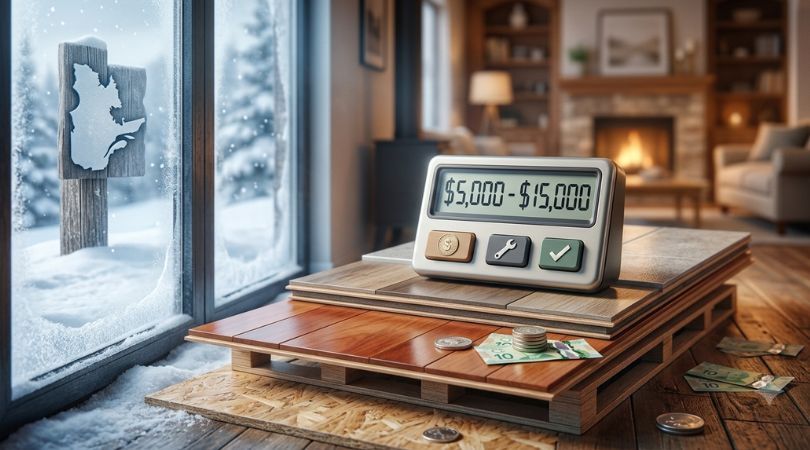
You’re dealing with some of the most demanding seasonal conditions in North America for flooring. Bone-dry indoor air from October to April. Humidity that climbs back up in summer. Ground moisture pushing through basement slabs. Salt and slush tracked through entryways five months of the year. And radiant heating systems that some materials simply can’t tolerate.
Choosing the best flooring for cold climate conditions in Quebec isn’t about finding what looks good in a showroom. It’s about understanding what happens to a material when you run your heating at full tilt for a Quebec winter — and then watch humidity recover in June.
What Quebec’s Climate Actually Does to Flooring
Here’s the mechanics of it. When outdoor temperatures drop, you start heating your home. Modern heating systems — whether forced-air, baseboard electric, or radiant — remove moisture from indoor air as a byproduct of warming it. Without active humidification, relative humidity in a Quebec home can fall below 30% by mid-January.
Wood is hygroscopic: it gains and loses moisture based on what’s happening in the air around it. At 30% humidity, wood contracts. Planks pull away from each other, leaving small gaps. In solid hardwood, you’ll sometimes hear small cracking or popping sounds as the wood moves. This is normal — but it’s alarming to homeowners who weren’t prepared for it.
Come spring, the heating backs off and outdoor humidity returns. Wood reabsorbs moisture and expands. In a healthy, well-installed floor, the gaps close. In a floor that was installed without proper acclimation, or where the humidity swings are severe, that repeated expansion and contraction can cause cupping, crowning, or permanent warping over time.
The right flooring for cold weather in Quebec is one that either handles this cycle naturally, resists it by design, or is installed in a way that accounts for it.
“We’ve seen floors fail within the first winter that looked perfect at installation. Usually it comes down to three things: the wrong product for the space, skipped acclimation, or a humidity problem the homeowner didn’t know they had. Quebec winters are unforgiving if you get those wrong.”
— Sefi Dollinger, Owner, Planchers Bellefeuille | Planchers Bellefeuille, serving Quebec homeowners since 1983
The Best Flooring Options for Quebec Homes
1. Engineered Hardwood — The Best of Both Worlds
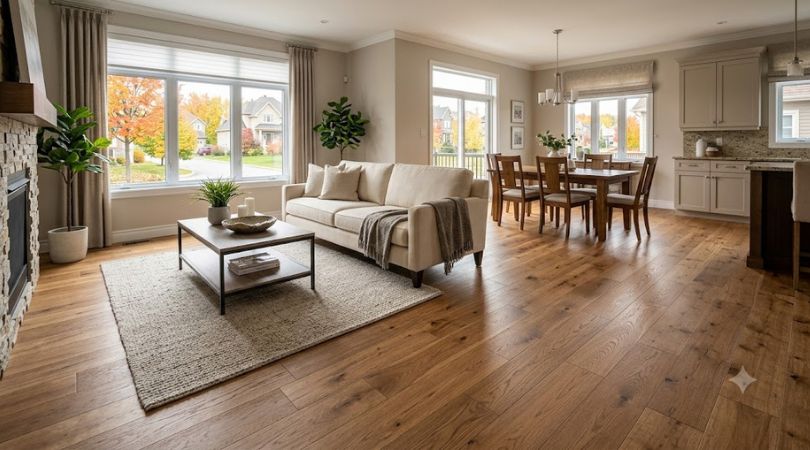
For most Quebec homeowners who want the look and feel of real wood, engineered hardwood is the strongest recommendation. The cross-ply construction — alternating layers of wood bonded at opposing grain directions — resists the expansion and contraction that affects solid wood significantly.
You get a genuine hardwood surface. The warmth, the texture, the character — it’s all real. But the core is built to stay stable when humidity fluctuates. It works over concrete subfloors, pairs well with most radiant heating systems (check manufacturer specs for specific temperature limits), and can be installed in spaces where solid hardwood would be a risk.
- Recommended humidity range: 35–55% — more forgiving than solid hardwood
- Works on concrete subfloors — important for Quebec slab construction
- Compatible with many radiant heating systems
- Genuine wood surface that can typically be refinished at least once
2. Luxury Vinyl Plank (LVP/SPC) — Maximum Stability
Vinyl flooring — particularly SPC (Stone Plastic Composite) — is the most dimensionally stable flooring option available. The rigid limestone-PVC core doesn’t expand or contract the way wood-based products do, making it nearly immune to the seasonal humidity swings that challenge everything else.
SPC also improved dramatically in the last decade. High-end SPC products now feature realistic wood textures and visuals that are difficult to distinguish from engineered hardwood in everyday living.
For Quebec basements, mudrooms, entryways, and any space where moisture is a real concern, SPC vinyl is often the most reliable long-term choice available. It doesn’t care about humidity. It doesn’t care about cold concrete. It just performs.
- 100% waterproof — unaffected by moisture from above or below
- Dimensionally stable across wide humidity and temperature ranges
- Ideal for basements and below-grade applications
- Works directly over concrete with proper vapor barrier
3. Solid Hardwood — On Its Own Terms
Solid hardwood in a Quebec home is not a bad choice — it’s a choice that requires commitment. The floor can last a lifetime, be refinished many times, and add genuine property value. But it requires active humidity management: a whole-home humidifier is essentially non-negotiable if you want solid hardwood to perform properly through Quebec winters.
It should not be installed below grade, on concrete, or in spaces where humidity control is difficult. When those conditions are met, it’s one of the most rewarding floors you can have.
- Target humidity: 35–50% year-round — requires active management
- Above-grade, wood subfloor installations only
- Not suitable for basements or concrete slabs
- Maximum refinishing potential and lifespan when properly maintained
4. Laminate — With Important Caveats
Quality laminate performs well in dry, controlled environments. Its aluminum oxide wear layer is extremely scratch-resistant, and modern laminate products look very convincing.
The issue in Quebec is moisture. Standard laminate with an HDF core will swell and delaminate if water gets through the joints — and in Quebec entryways and basements, that’s a real risk. Waterproof laminate products with sealed cores perform significantly better, but SPC vinyl offers equivalent or better moisture protection at comparable price points.
Laminate is a reasonable choice for dry main-level spaces. It’s not the right call for moisture-exposed areas in a Quebec home.
Installation: The Steps Quebec Makes Non-Negotiable
Even the right product fails with poor installation. The steps that matter most in Quebec’s climate:
Acclimation
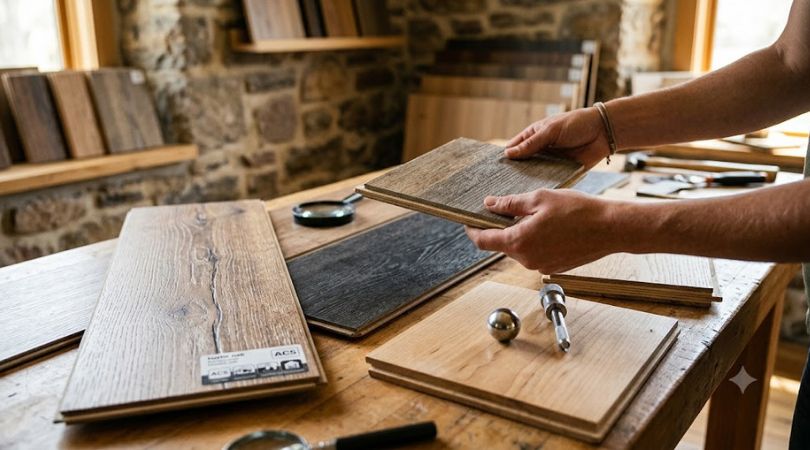
Flooring materials must be stored inside the home — at normal living temperature and humidity — before installation. Hardwood typically needs 3–7 days. This allows the material to adjust to the indoor environment before being fastened in place. Install without acclimating and you guarantee movement after installation, sometimes dramatic movement within the first heating season.
Moisture Testing
Concrete subfloors hold moisture that isn’t visible at the surface. Moisture meters and calcium chloride tests are standard tools for professional installers. Skipping moisture testing is one of the most common — and most expensive — DIY mistakes we see. The resulting floor failures typically appear 6–12 months after installation, after the first full seasonal cycle.
Expansion Gaps
Every floating floor needs a perimeter expansion gap to accommodate seasonal movement. In Quebec’s wide humidity range, these gaps aren’t optional. The correct gap size depends on the specific product, room dimensions, and expected humidity range. Getting this wrong leads to buckling in summer — a predictable and entirely avoidable problem.
Underlayment and Vapor Barriers
The right underlayment provides thermal insulation, moisture protection, and sound absorption. For cold-climate installations — particularly anything near or below grade — underlayment with a vapor barrier component is often essential. It’s also what separates a floor that feels warm underfoot from one that feels cold despite a good product on top.
Managing Indoor Humidity: The Maintenance You Can’t Skip
For wood-based flooring in Quebec, managing indoor humidity year-round is as important as the installation itself. Target range: 35–55% relative humidity.
- Below 30%: hardwood will gap; potential for permanent damage in severe cases
- Above 60%: risk of cupping, mold growth under the floor
Practical tools:
- Whole-home humidifier integrated with your forced-air system — the most effective option
- Portable humidifiers for supplemental zones
- Hygrometer — a simple device that costs under $20 and tells you exactly where your humidity stands
- HRV (Heat Recovery Ventilator) — increasingly common in Quebec new construction; helps manage fresh air and moisture balance year-round
This isn’t optional maintenance for Quebec homeowners with hardwood floors. It’s the operating condition the floor requires. Think of it the same way you think about changing your furnace filter — it’s just part of owning the floor properly.
A Quick Decision Framework
| Your Situation | Recommended Option |
| Main floor, wood subfloor, will manage humidity | Solid hardwood or engineered hardwood |
| Main floor, concrete subfloor | Engineered hardwood or SPC vinyl |
| Basement renovation | SPC vinyl (primary rec.), engineered hardwood (conditional) |
| Entryway or mudroom | SPC vinyl |
| Radiant heating system | Engineered hardwood or SPC vinyl (check specs) |
| Budget-conscious, dry main-level space | Quality laminate or LVP |
Ready to Choose the Right Floor?
Not sure what’s right for your specific space? Visit our Saint-Jérôme showroom or book a consultation with our flooring specialists.
We’ll assess your subfloor conditions, discuss your humidity management setup, and recommend flooring that’s built for Quebec — not just any climate.
📍 450, boul. Roland-Godard, Saint-Jérôme, QC | 📞 (450) 431-1643 | 🌐 planchersbellefeuille.com
Planchers Bellefeuille is a family-owned flooring and millwork specialist serving Quebec homeowners since 1983. A division of DZD Hardwood Inc., our RBQ and NWFA certified installers serve the Saint-Jérôme region and greater Montréal area.