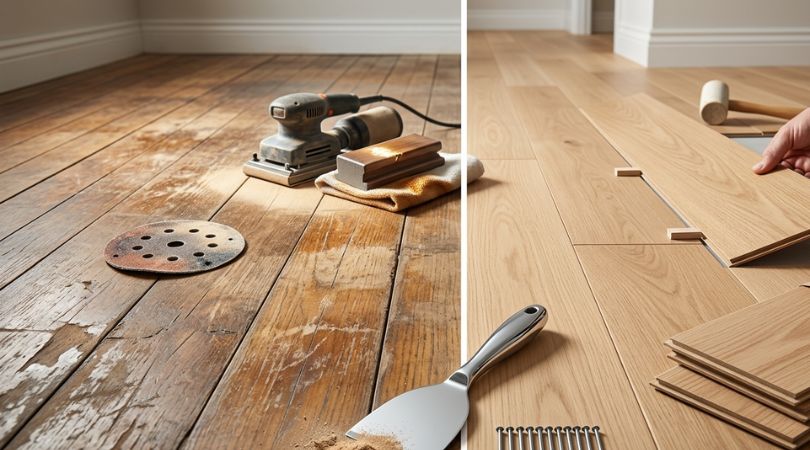
Refinish your hardwood if the boards are solid, the wear is on the surface, and there is enough wood left to sand. Replace it if the boards are warped, water-damaged, already sanded to the limit, or if you want a different species or width. Most tired floors can be saved. The decision comes down to what is happening under the scratches, not the scratches themselves.
Read The Floor Before You Spend A Dollar
The scratches you notice are almost never the real question. A dull, scuffed floor with sound boards underneath is a sanding job, nothing more. The signals that push a floor toward replacement live deeper: warping, movement, and damage a sander cannot reach.
Get down at floor level in raking light from a window. Run your hand across the boards. What you feel and see in five minutes tells you more than any online calculator. If the wood is flat and firmly fixed, you are very likely sanding. If it moves, lifts, or the damage runs into the grain, keep reading.
The Signs A Floor Can Still Be Sanded
Good news is common here. Solid hardwood is built to be renewed, and many floors that look finished have decades left. Look for these green lights.
- The boards are flat and tight,with no cupping, crowning, or soft spots.
- The damage is on the surface:scuffs, light scratches, worn finish, greying, pet stains sitting on the finish.
- The boards are well fastened,with no loose planks or lifting at the ends.
- The gaps are seasonal,tight in summer, not permanent splits.
A floor that ticks these boxes will look close to new after a sand and finish, at a fraction of the cost of replacement.
The Sanding Math You Cannot Ignore
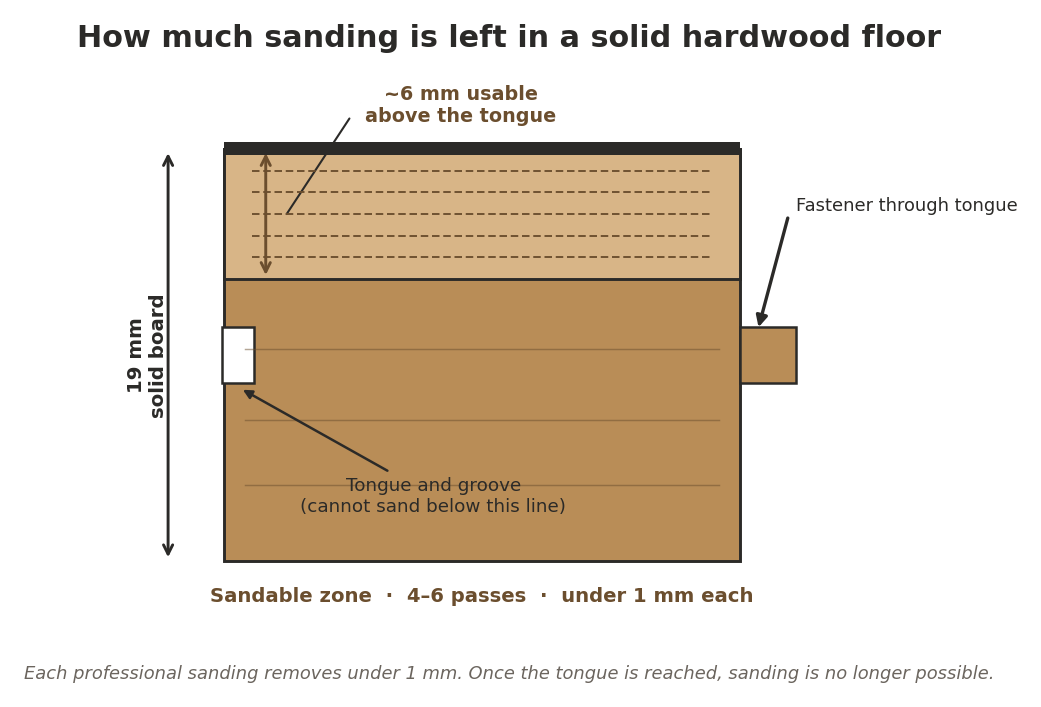
Every sanding removes a thin layer of wood, and there is a limit to how many times you can start over. Solid hardwood is about 19 mm thick, but only the wood above the tongue and groove, roughly 6 mm, is usable. Each professional sanding removes less than a millimetre.
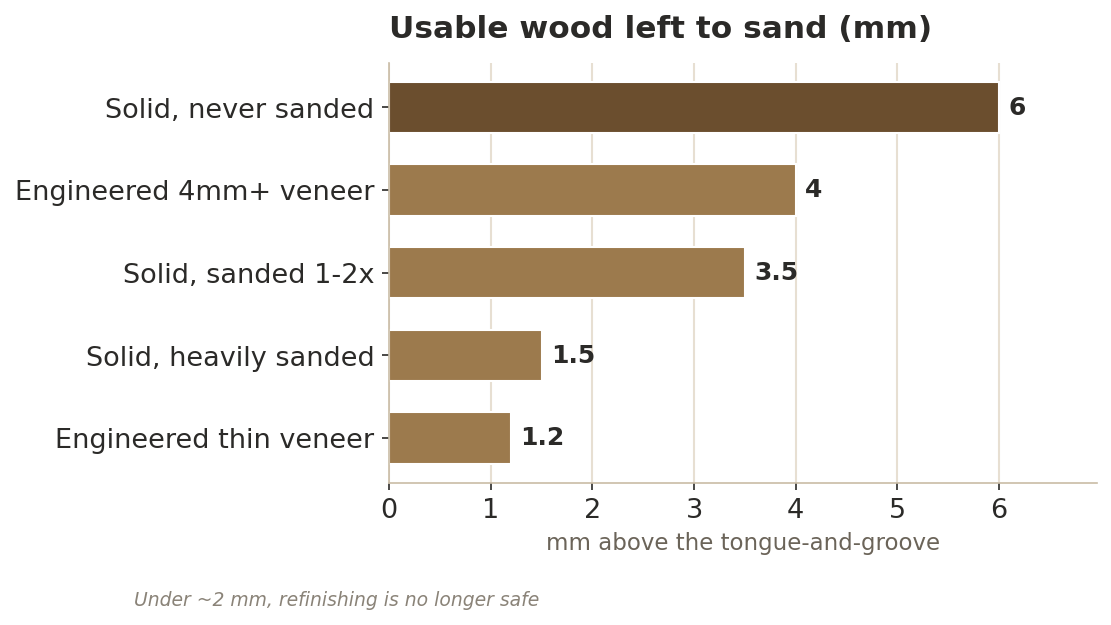
| Floor Type | Usable Wood Above the Tongue | Realistic Sandings Left |
|---|---|---|
| Solid, never sanded | ~6 mm | 4 to 6 |
| Solid, sanded once or twice | ~3 to 4 mm | 2 to 4 |
| Solid, heavily sanded | Under 2 mm | 0 to 1 |
| Engineered, 4 mm veneer or more | 4 mm+ | 1 to 2 |
| Engineered, thin veneer | Under 2 mm | 0 |
If nail heads appear or the tongue is exposed at the edge of the boards, the floor has been sanded to its limit and sanding is no longer an option. A professional can gauge remaining thickness at a floor vent or a doorway edge before anyone touches a sander.
Understanding Cupping, Crowning, And Warping
These three terms decide a lot of refinish-or-replace calls, and most homeowners mix them up. All three are the wood’s response to uneven moisture, and reading them correctly tells you whether sanding will help or waste money.
- Cupping is when the edges of a board rise higher than its centre, so the floor looks like rows of shallow troughs. It happens when the underside of the board is wetter than the top, which draws the edges up. Cupping from a one-time event, like a dishwasher leak that has since dried, often flattens on its own over weeks once moisture equalizes. Sand a cupped floor before it has fully dried and flattened and you create the next problem.
- Crowning is the reverse: the centre of the board rises higher than the edges. This usually happens when a cupped floor was sanded flat too early, and then the wood dried and the middle bowed up. Crowning is often a self-inflicted wound from impatient sanding, which is exactly why timing matters.
- Warping and buckling are more severe. Buckling is when boards lift entirely off the subfloor, usually from a major water event or a failed vapour barrier. Buckled floors almost always need replacement, at least in the affected area.
The rule that saves money: fix the moisture source, let the floor sit and equalize for weeks, and only then assess. Many floors that look ruined in the moment flatten back to sandable condition once they dry.
When Replacement Is The Smart Call
Sometimes new is the right investment. Replace when boards are warped or buckled from a moisture problem, when water or a leak has blackened the wood into the grain, when the floor has already been sanded to the tongue, or when insects or rot are involved. Structural problems do not sand out.
There is also the honest reason: you want something different. A narrow 1970s red oak floor in a dark stain is sound but dated. If you want wide-plank white oak or a natural matte look, sanding the old floor will not get you there. That is a valid reason to replace, and I would rather a client spend once on the floor they truly want than twice chasing it.
Common Scenarios And What I Actually Recommend
Most calls fall into a handful of patterns. Here is how each usually resolves.
Deep pet stains. Urine that has soaked through the finish into the wood leaves black tannin stains. If the staining is on the finish, sanding removes it. If it has penetrated the grain, sanding will not lift it, and the honest fix is to replace the affected boards and blend, then sand the whole floor to unify the colour. A skilled installer can weave in matching boards so the repair disappears.
Selling the home. Refinishing has one of the best returns of any pre-sale project. Buyers respond strongly to floors that look cared for, and a refinish costs a fraction of replacement while photographing beautifully. Unless the floor is genuinely failing, refinish before you list. Replacement rarely earns back its full cost at sale.
Partial refinishing. People often ask to refinish one room and leave the rest. It works only if the adjoining floors are a clearly separate area, because matching a fresh finish to an aged one in the same sightline is nearly impossible. Sun fading and finish ambering mean a newly sanded section will not match a ten-year-old one beside it. Refinish by continuous visual zone, not by room.
Water damage. A contained, dried-out spill often sands out. Ongoing or large-scale water damage that has reached the subfloor usually means replacement of the affected area plus a fix for the source. Never refinish over a floor that is still reading high moisture, since the problem returns.
Squeaks and movement. Refinishing does not fix squeaks. If the floor moves or squeaks underfoot, that is a fastening or subfloor issue to address before, not during, a refinish.
Can Engineered Floors Be Refinished?
Yes, but with limits, and the detail that matters is veneer thickness. An engineered floor can only be sanded and refinished if its real-wood wear layer is thick enough, generally 4 mm or more. A good engineered floor with a 4 to 6 mm wear layer can take one, sometimes two light sandings. Thin-veneer engineered products sold at big box stores, often with a 1 to 2 mm wear layer, usually cannot be sanded at all.
The reason is simple geometry. Below the veneer sits the plywood or HDF core, and if a sander reaches it, the floor is finished. On a thin veneer there is no margin for the pass, and even edge sanding risks breaking through at the bevels.
If you do not know your veneer thickness, a professional can check at a vent or a door edge before anyone starts. For a floor that cannot be sanded, a screen and recoat, which abrades only the finish and adds a fresh top coat, can still refresh the surface without touching the wood. Our engineered hardwood page lists the wear-layer thicknesses we carry, which is worth checking if you are buying new with future refinishing in mind.
Cost, Dust, And How Long It Takes
The gap between the two paths is wide. Refinishing a typical main floor costs roughly a third to half the price of tearing out and installing new hardwood, and it is faster. Plan on two to four days for a refinish including dry time, with modern dustless sanding keeping the mess far below the old drum-sander horror stories. A full replacement means demolition, disposal, subfloor prep, installation, and finishing, often a week or more with far more disruption.
Treat any figures as planning ranges for the Saint-Jerome and greater Montreal area, not quotes. Cost swings with the species, the finish system, the floor’s condition, and whether stairs or intricate borders are involved. Stairs in particular add labour, because each tread is sanded by hand.
A note on finish type. An oil-based polyurethane is cheaper and ambers over time, giving a warm tone, but it takes longer to cure and smells strongly during application. A water-based finish costs more, dries faster, stays clear, and lets you back on the floor sooner. In an occupied home in winter, when you cannot air the place out, water-based is usually worth the premium.
After The Refinish: Making It Last
A refinished floor is a fresh start, and how you treat the first month sets the tone for years. Water-based finishes reach full cure in about a week and oil-based in two to three weeks, so keep area rugs off and go easy on heavy furniture until then, since a rug trapped on a curing finish can leave a permanent haze.
Longer term, the routine is simple. Sweep or vacuum grit, since grit is what actually scratches a finish. Damp mop with a hardwood-specific cleaner, never a steam mop, and never let water pool. Add felt pads under furniture and refresh them yearly. Keep indoor humidity between 35 and 55 percent through the Quebec seasons to prevent the gapping and cupping that shorten a floor’s life. Done right, a refinish buys you another decade or more before the next one. Our hardwood maintenance guide for Quebec winters covers the seasonal routine in detail.
Refinish Versus Replace, Side By Side
| Factor | Refinish | Replace |
|---|---|---|
| Cost | One third to one half of replacement. | Highest, includes demolition and disposal. |
| Disruption | Typically 2 to 4 days with dustless sanding. | Usually a week or more with complete floor removal and installation. |
| Design Flexibility | Limited to a new stain color and sheen. | Choose any wood species, plank width, finish, or installation pattern. |
| Lifespan Added | Typically 10+ years per refinishing. | 50+ years for a new solid hardwood floor with proper care. |
| Resale Value | Strong return and excellent for preparing a home for sale. | Rarely recovers the full investment at resale. |
| Environmental Impact | Minimal, since the existing hardwood is preserved. | Requires new materials and sends the old flooring to landfill. |
| Best When | The boards are structurally sound and there is enough wood remaining to sand. | The floor has severe warping, deep water damage, or you want a completely new look. |
Decide With A Professional
“I have talked more people out of replacing than into it,” says Sefi Dollinger, Owner of Planchers Bellefeuille, serving Quebec homeowners since 1983. “A homeowner books an assessment sure the floor is done, and half the time there are three good sandings left in it. The reverse happens too, someone sands a floor already down to the tongue and the nails come up. Fifteen minutes on your knees with the floor tells the truth. Have an honest eye look at it before you decide.”
If you are staring at a tired floor and not sure which way to go, we will look at it and tell you straight. Our hardwood flooring page shows the species we carry if replacement turns out to be the answer.
Frequently Asked Questions
How do I know if my floor can be refinished?
Check whether the boards are flat and firmly fastened, and whether nail heads or the tongue are visible. Flat, sound boards with wood above the tongue can be refinished. Exposed tongues or nail heads mean the floor is at its sanding limit.
How many times can a hardwood floor be refinished?
Solid hardwood typically allows four to six sandings across its life, because only the roughly 6 mm above the tongue is usable and each sanding removes less than a millimetre. Engineered floors allow zero to two, depending on veneer thickness.
Is it cheaper to refinish or replace hardwood?
Refinishing costs roughly a third to a half of replacement and is faster. Replacement only makes financial sense when the floor is structurally failing or you want a different species, width, or look.
Can water-damaged hardwood be saved?
Sometimes. A one-time spill that has dried often flattens and sands out. Ongoing leaks or water that has blackened the grain or reached the subfloor usually require replacing the affected boards and fixing the source first.
What is the difference between cupping and crowning?
Cupping is when board edges rise above the centre, from moisture underneath. Crowning is when the centre rises above the edges, often because a cupped floor was sanded flat before it dried. Both are moisture-driven and need the source fixed first.
Will refinishing fix gaps between my boards?
No. Seasonal gaps are the wood shrinking in dry winter air and usually close by summer. Refinishing does not change board width. Persistent large gaps can be filled during a refinish, but the fill can crack as the wood moves.
Can I refinish just one room?
Only if it is a visually separate area. A freshly sanded floor will not match an aged floor in the same sightline because of sun fading and finish ambering. Refinish by continuous visual zone rather than by room.
Does refinishing add value when selling?
Yes, strongly. Refinished floors show well and cost far less than replacement, making them one of the better pre-sale investments. Full replacement rarely recovers its cost at sale.
How long does a refinished floor take to cure?
Water-based finishes are walkable in hours and fully cured in about a week. Oil-based finishes take two to three weeks to cure fully. Keep rugs and heavy furniture off until the finish has cured.
Can engineered hardwood be sanded?
Only if the wear layer is 4 mm or thicker, which allows one or two light sandings. Thin-veneer engineered floors cannot be sanded. A screen and recoat can still refresh the finish without sanding the wood.
What is a screen and recoat?
It is a light abrasion of the existing finish followed by a fresh top coat, with no sanding into the wood. It refreshes a dull but sound finish, works on thin-veneer engineered floors, and costs less than a full refinish.
Should I refinish before or after other renovations?
After. Sand and finish floors last, once painting, cabinetry, and heavy trades are done, so the fresh finish is not scratched or dinged by other work. Protect the floor if any work must follow.
Visit our Saint-Jerome showroom or book a consultation.
450, boul. Roland-Godard, Saint-Jerome, QC | (450) 431-8789 | planchersbellefeuille.co