Choose prefinished hardwood if you want a tougher factory finish, a faster install, and almost no dust or fumes in an occupied home. Choose site-finished hardwood if you want a perfectly smooth surface, a custom stain, or seamless boards with no micro-bevel between them. Both are real hardwood and both last for decades. The decision is about finish durability, mess, timeline, and the look you are after, not about the wood itself.
The one difference that drives everything
Prefinished and site-finished flooring start as the same thing: real wood boards. The difference is where the finish goes on. Prefinished boards are sanded, stained, and coated in a factory, then delivered ready to install and walk on. Site-finished boards arrive raw, get installed, then are sanded and finished in your home.
That single distinction, factory versus on-site, cascades into every other tradeoff: how tough the finish is, how much mess the job makes, how long it takes, how the surface looks, and how it gets refinished years later. Understand that one fork and the rest of the decision falls into place.
Finish durability: the factory advantage
The biggest practical difference is how tough the finish is. Factory prefinished boards are coated with multiple layers of finish infused with aluminum oxide, then cured under ultraviolet light in conditions no home can match. The result is one of the hardest, most scratch-resistant surfaces available in wood flooring, and it usually carries a long finish warranty.
Site-applied finishes cannot reach that hardness, because you cannot bake aluminum oxide into polyurethane and cure it with UV lamps in a living room. A quality site finish is durable and beautiful, but on raw resistance to scratches and wear, the factory finish wins. For a busy home with kids and dogs, that matters, and it is why I steer high-traffic households toward prefinished more often than not.
Where site-finished pulls ahead: the look
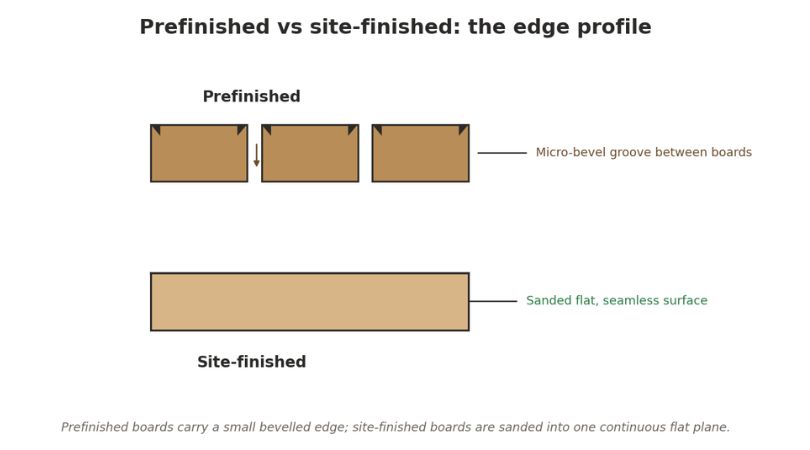
Site-finished flooring has one advantage that prefinished cannot copy: a perfectly flat, seamless surface. Because the boards are sanded flat as a single field after installation, there is no bevel between them. The floor reads as one continuous plane, which is the classic look people picture in a heritage home or a high-end renovation.
Prefinished boards almost always have a small bevelled edge, a micro-bevel, milled into each plank. It hides slight height differences between boards and protects the finished edge during handling, but it also creates a fine groove between every plank. Most people never notice it. Some clients want the seamless site-finished look and nothing else will do, and that is a completely valid reason to choose it.
Custom colour versus factory range
Colour is the other place site-finished wins on flexibility. Because the wood is raw when it arrives, you can stain it any shade you want, match an existing floor exactly, or create a custom tone that no manufacturer sells. For a renovation where new flooring has to blend seamlessly into an old floor, site-finished is often the only way to get a true match.
Prefinished flooring comes in a fixed factory range. That range is wide and beautiful, but it is fixed. You are choosing from what the manufacturer makes, not creating your own colour. For most projects the range is more than enough. For an exact match or a bespoke tone, raw wood finished on site is the answer.
The comparison that matters
Here is how the two approaches line up across the factors that actually drive the decision.
| Factor | Prefinished | Site-Finished |
|---|---|---|
| Finish Hardness | Highest, aluminum-oxide UV-cured | Good, but softer than factory |
| Surface Look | Micro-bevel between boards | Seamless, perfectly fla |
| Colour Options | Fixed factory range | Any custom stain or exact match |
| Dust & Fumes | Almost none | Significant sanding dust and finish fumes |
| Installation Timeline | Walk on it the same day | Several days including cure time |
| Warranty | Long finish warranty | Depends on the finisher |
| Refinishing later | Sand off the bevel first | Straightforward |
| Best For | Busy homes, occupied installs, speed | Custom colour, seamless look, heritage feel |
Mess, fumes, and living through it
If you are living in the house during the install, this row of the table often decides everything. Site finishing means sanding your floors in place, which creates fine dust, followed by applying finish, which releases fumes while it cures. Modern dustless sanding controls the mess far better than the old drum-sander days, but there is still disruption, and you cannot use the room until the finish cures.
Prefinished flooring skips all of it. The boards arrive finished, go down, and you walk on them the same day. No sanding dust drifting through the house, no finish smell, no rooms closed off for days. In a Quebec winter, when you cannot open the windows to air the place out, that difference is not small. For an occupied home in January, prefinished is often the practical answer. Our indoor air quality guide touches on the emissions side of finishing.
Timeline and cost
The two approaches cost differently, and it is not a simple case of one being cheaper. Prefinished flooring costs more per square foot for the material, because you are buying a finished product, but it installs faster and needs no finishing labour, which pulls the total closer together. Site-finished starts with cheaper raw boards but adds several days of sanding and finishing labour plus cure time.
On timeline, prefinished is clearly faster. A prefinished floor is usable the day it goes down. A site-finished floor needs installation, then sanding, then multiple finish coats, each with dry time, and then a cure period before furniture returns. Plan on a week or more for site-finished against a day or two for prefinished of the same size.
How the Quebec climate factors in
Our climate touches both options in the same way it touches all wood flooring: through humidity. Whichever you choose, the wood must acclimate to the room before installation, and the home should hold 35 to 55 percent relative humidity year round to prevent the seasonal gapping and cupping that dry winter air causes. That rule does not change between prefinished and site-finished.
There is one climate-specific wrinkle worth naming. Site finishing in deep winter is harder, because finishes cure best in a warm, moderately humid, well-ventilated space, and a sealed Quebec house in January is dry and hard to ventilate. Prefinished sidesteps this entirely, since the curing already happened in a factory. If you are finishing on site in winter, a good installer will manage temperature and airflow carefully. Our hardwood maintenance guide for Quebec winters covers the humidity discipline that protects either floor.
Refinishing down the road
Both floors can be refinished, with one difference in the first pass. A site-finished floor is flat, so the first sanding is straightforward. A prefinished floor has that micro-bevel, and the first full refinish has to sand the bevels away to create a flat surface, which removes a little extra wood. After that first refinish, a prefinished floor behaves like any other.
This is rarely a reason to choose one over the other, since a refinish is a decade or more away when you buy. But it is worth knowing that the seamless look you can get by refinishing a prefinished floor is the same seamless look site-finished gives you from the start.
So which should you choose?
For most Quebec homes, prefinished is the practical winner: a tougher finish, no mess, no fumes, and a floor you can use the same day, which matters most in an occupied winter home. Choose site-finished when you have a specific reason: a custom colour, an exact match to an existing floor, or a heritage-style seamless surface where the micro-bevel would bother you. Neither is a mistake. They are two routes to a real hardwood floor that lasts a lifetime.
The showroom perspective
“I get asked which one is better, and the honest answer is which one is better for you,” says Sefi Dollinger, Owner of Planchers Bellefeuille, serving Quebec homeowners since 1983. “A young family living in the house through the job almost always wants prefinished, because nobody wants sanding dust in the kitchen and a bedroom they cannot use for four days. But I had a client restoring a 1920s home who needed the exact honey tone of the original floors, and only site finishing could match it. Tell me your priority, mess or a custom look, and the choice makes itself.”
Frequently asked questions
1. What is the difference between prefinished and site-finished hardwood?
Prefinished boards are sanded, stained, and coated in a factory and arrive ready to walk on. Site-finished boards arrive raw and are sanded and finished after installation in your home. Both are real hardwood; the difference is where the finish is applied.
2. Is prefinished hardwood more durable than site-finished?
On finish hardness, yes. Prefinished floors use aluminum-oxide finishes cured under UV light in a factory, producing a harder, more scratch-resistant surface than any on-site finish can reach. Site finishes are durable but softer by comparison.
3. Does prefinished hardwood have grooves between the boards?
Yes, a small bevelled edge called a micro-bevel is milled into each plank. It hides slight height differences and protects the edges, and creates a fine groove between boards. Site-finished floors are sanded flat with no bevel.
4. Can you get a custom colour with prefinished hardwood?
No, prefinished comes in the manufacturer’s fixed range. For a custom stain or an exact match to an existing floor, you need site-finished, because the raw wood can be stained any shade before finishing.
5. Which is faster to install, prefinished or site-finished?
Prefinished, by a wide margin. It is walkable the same day it goes down. Site-finished needs installation, then sanding, then multiple finish coats with dry time and a cure period, often a week or more for the same floor.
6. Is site-finished hardwood messier?
Yes. Site finishing involves sanding your floors in place, which creates dust, and applying finish, which releases fumes while curing. Prefinished flooring produces almost no dust or fumes because the finishing already happened in a factory.
7. Which is better for an occupied home in winter?
Prefinished, usually. It creates no sanding dust or finish fumes, which matters when a Quebec winter keeps the windows shut. Site finishing is harder to ventilate and cure in a sealed, dry winter house.
8. Can prefinished hardwood be refinished later?
Yes. The first refinish has to sand off the micro-bevel to create a flat surface, which removes a little extra wood, but after that it refinishes like any hardwood floor. Both types can be renewed multiple times.
9. Is prefinished or site-finished more expensive?
Prefinished costs more per square foot for the material but saves on finishing labour and time. Site-finished starts with cheaper raw boards but adds days of sanding and finishing labour. Totals are often closer than the material prices suggest.
10. Which looks more high-end?
It depends on the look you want. Site-finished gives a seamless, perfectly flat surface prized in heritage and luxury renovations. Prefinished offers a wide range of refined factory colours and textures. Neither is inherently more high-end.
11. Do both need to acclimate to my home?
Yes. All hardwood, prefinished or site-finished, must acclimate to the room before installation, and the home should stay between 35 and 55 percent humidity year round to prevent seasonal gapping and cupping. The climate rules are identical.
12. Can I match a new prefinished floor to my old hardwood?
Only approximately, since prefinished comes in set colours. For a true seamless match to an existing floor, site-finished is the reliable choice, because the new wood can be stained to match the old exactly before finishing.