
The best floor for a high-traffic area is one with a tough protective surface, a top coat that can handle the grit and moisture tracked across it, and a base layer that doesn’t show damage from below. For most Quebec homes, that points to a premium luxury vinyl, a good engineered hardwood with a factory finish, or porcelain tile. The very cheapest floors at the big-box stores almost never qualify.
Before You Start Shopping
Before we talk about specific products, get clear on what your space actually is. A 200 sq ft front entry shared by three school-age kids and a dog is different from a 600-foot hallway running through a duplex. Both are “high traffic.” How much traffic, and what kind, is what determines the right floor.
What “High Traffic” Actually Means
We measure traffic in passes per day. A “pass” is one person walking across a section of floor in one direction. The general bands:
- Light home use: under 100 passes per day. Bedrooms, guest rooms.
- Medium home use: 100 to 400 passes. Living rooms, dining rooms, family rooms.
- Heavy home use: 400 to 1,000 passes. Entryways, mudrooms, kitchens, hallways, stairs.
- Light commercial: 1,000 to 3,000 passes. Small offices, private clinics.
- Moderate commercial: 3,000 to 10,000. Boutique retail, restaurants, dental clinics.
- Heavy commercial: 10,000+. Grocery stores, big-box, hotel lobbies.
Most homeowners underestimate their own traffic. A family of four with a dog and a winter mudroom routine puts about 800 passes per day across the front entry through a Quebec season. That’s heavy home use, almost commercial-grade. The floor needs to match.
The Number That Actually Predicts How Long It’ll Last
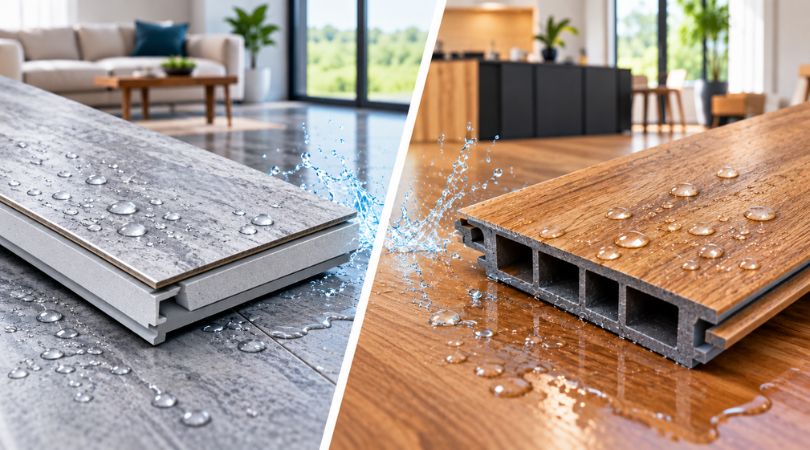
For wood floors, the “wear layer” is the top section of real wood that protects the layers underneath. The thicker it is, the more times you can sand and refinish the floor. A 2 mm top layer can be refinished once. A 4 mm layer can be refinished two or three times. A 6 mm layer can be refinished as many times as a solid wood floor.
For luxury vinyl, the wear layer is the clear protective coat baked onto the top. It’s measured in mils (a tiny fraction of an inch). A vinyl made strictly for bedrooms might have a 6 to 12 mil top coat. Anything below 12 mil will scratch and dull in a busy household within two or three years. Here’s the simple version of what I recommend:
- Bedrooms only: 6 mil is fine, 12 mil is better.
- Living rooms: 12 mil minimum, 20 mil ideal.
- Hallways, kitchens, entries: 20 mil at the very least.
- Commercial use: 28 mil or more.
For laminate, the AC rating does the same job. AC3 is fine for normal household rooms. AC4 is what I quote for any busy Quebec hallway or kitchen. AC5 and AC6 are commercial-only. For tile, anything PEI 3 or above will work in a normal home, and PEI 4 is what we recommend for any space that catches winter boot traffic.
High-Traffic Floors, Ranked
| Rank | Material | Best for | Realistic lifespan in a Quebec hallway | Notes |
| 1 | Porcelain tile (PEI 5) | Commercial-grade traffic | 30+ years | Cold underfoot, best paired with heated floor |
| 2 | Large-format sintered porcelain | Commercial-grade traffic | 30+ years | Premium price, gorgeous in photos |
| 3 | Rigid-core luxury vinyl, 28 mil top coat | Light commercial | 18 to 25 years | The quietest hard surface, stays flat year-round |
| 4 | Engineered hardwood, 4 mm+ wear layer | Heavy home use | 25 to 40 years (refinished) | Real wood feel, holds value at resale |
| 5 | High-density laminate, AC4 | Heavy home use | 12 to 18 years | Cost-effective, just watch the seams near water |
| 6 | TORLYS engineered with sealed joints | Heavy home use to light commercial | 20 to 30 years | Proven in Quebec winters, easy to replace one plank |
| 7 | Solid hardwood | Medium home use | 15 to 25 years before refinishing | Beautiful but dents under stilettos and dog claws |
| 8 | Standard ceramic tile | Normal home use | 10 to 20 years | The grout usually fails before the tile does |
| 9 | Builder-grade laminate, AC3 | Medium home use | 5 to 10 years in heavy zones | Skip for hallways and kitchens |
| 10 | Sheet vinyl | Light home use | 5 to 8 years | Fine for laundry rooms, wrong for entryways |
The ranking is specific to Quebec conditions. Salt, ice-melt, and our humidity swings shift the math compared to a drier climate somewhere else. For more on below-grade picks, see our basement and cold-climate flooring guide.
Stairs and Hallways Need Their Own Thinking
Stairs are the hardest test in any home. Every step puts your full body weight on the front edge of the tread, and your foot rotates slightly as you push off. That combination chews through soft finishes within months.
For wood stairs, I recommend solid hardwood or thick-veneer engineered with a factory-baked finish on the front edge of each step. That edge piece (called the nosing) should be milled from the same wood species as the rest of the step. It’s the joint where most renovation callbacks come from.
For hallway runs longer than 15 feet, how stable the floor is across the seasons matters more than how it looks. A long plank made from a less stable material will show visible gaps through a Quebec winter. Rigid-core vinyl, engineered hardwood, and porcelain handle the length without trouble. Long solid hardwood planks and floating laminate often don’t.
“On stair installs, the nosing detail is what tells me whether the homeowner is going to call me back in five years,” says Sefi Dollinger, Owner of Planchers Bellefeuille, serving Quebec homeowners since 1983. “A factory-finished nosing flush with the step lasts. A field-finished one usually doesn’t.”
For a deeper look at stair construction choices, our post on custom stairs vs prefabricated stairs covers the trade-offs.
How Much Cleaning You’ll Actually Do
A floor only hits its long lifespan if you give it the right care. The summary I give every client:
- Luxury vinyl: neutral pH cleaner, microfiber mop, no steam, no oil soaps. Vacuum entry zones twice a week to lift the grit before it sands the surface.
- Engineered hardwood: Bona Pro or whatever the manufacturer recommends, never wet-mop, and put a 6-foot walk-off mat at every exterior door.
- Porcelain tile: neutral pH cleaner, re-seal standard grout once a year, replace silicone in the expansion gaps every 5 to 7 years.
- Laminate: lightly damp microfiber only. Water at the seams is the enemy. Choose AC4 minimum if you want to mop with anything close to wet.
The single biggest thing you can do to extend any floor in a Quebec home is the entry mat system. A 6-foot walk-off mat at the exterior door catches about 80% of the grit that would otherwise reach your finished floor. Sand and salt are basically sandpaper. They wear down the protective coat every time someone walks across the entry. Skip the mats and you double how fast the floor wears.
How to Read Manufacturer Warranties
Warranties are marketing tools more than they are guarantees. The big number on the front (25-year, lifetime) almost always has a long list of exceptions, gets prorated as years pass, and excludes normal wear. Read the residential-versus-commercial section carefully. Many “lifetime” warranties drop to 5 years the moment a commercial setting is involved or an unapproved cleaner is used.
For an independent check on a manufacturer’s claims, the Resilient Floor Covering Institute publishes the standardized tests for abrasion, dimensional stability, and indentation that any honest brand uses.
FAQs
What’s the Most Durable Flooring for a Busy Household?
Porcelain tile and rigid-core luxury vinyl with a 28 mil top coat sit at the top for households with kids, pets, and Quebec winter boot traffic.
Can Hardwood Survive a Busy Hallway?
Yes, with the right product. Choose engineered hardwood with a 4 mm or thicker top veneer, a baked-on factory finish, and a harder wood species like white oak, hard maple, or hickory. Skip soft woods like pine or birch in heavy zones.
Is Laminate Okay for Kitchens?
Only if it’s AC4 or higher with sealed-edge protection, and only if you commit to wiping spills right away. For a busy Quebec kitchen, luxury vinyl is the safer call.
Do I Need a Heated Floor Under Porcelain in a Hallway?
Not really required, but nice in any space where you’ll be barefoot. A hallway you mostly walk through with shoes on tolerates unheated tile just fine.
How Long Should Walk-Off Mats Be at the Front Door?
Six feet of total mat length is the commercial standard. In a home, four feet is the practical minimum. Any less and abrasive grit reaches your finished floor.
Pick the Right Floor Before the Wear Shows Up
Our Saint-Jerome showroom keeps full-size samples of every product I mention above, plus the wear-test pucks the manufacturers send. Walk in, scratch them with the test tools, and see how each one holds up. That hands-on test beats any salesperson’s pitch.
Planchers Bellefeuille | 450, boul. Roland-Godard, Saint-Jerome, QC | (450) 431-1643