
The healthiest flooring for indoor air is a hard, sealed, low-emitting surface: solid or engineered hardwood with a low-VOC finish, GREENGUARD Gold or FloorScore certified resilient flooring, or porcelain tile. The floors to watch are cheap laminates and vinyls with no emissions certification, and wall-to-wall carpet, which traps allergens. In a Quebec home sealed tight for a long winter, what your floor releases and what it holds both matter more than most people realize.
Why your floor affects the air you breathe
A floor is one of the largest surfaces in your home, and it does two things to your air. It can release chemicals, called volatile organic compounds or VOCs, from adhesives, finishes, and core materials. It can also trap or shed allergens like dust, pet dander, and pollen depending on its surface.
For most of the year you might not think about it. Then the furnace comes on in November, the windows stay shut until April, and the air in the house recirculates for months. That is when a low-emitting, easy-to-clean floor earns its keep, and when a cheap off-gassing one becomes a daily exposure you cannot escape.
What VOCs actually are, in plain terms
VOCs are carbon-based chemicals that evaporate into the air at room temperature. In flooring they come from three places: the finish or coating, the adhesive used to install it, and the core material in engineered and laminate products, where formaldehyde-based resins are the usual concern.
Health Canada identifies indoor VOCs as a recognized air-quality issue, with formaldehyde among the compounds it tracks in homes. The important nuance is that emissions are highest when a product is new and fall off over time, a process called off-gassing. A floor that smells strongly for weeks after installation is telling you something. A certified low-emitting floor barely registers from day one.
The certifications that actually mean something
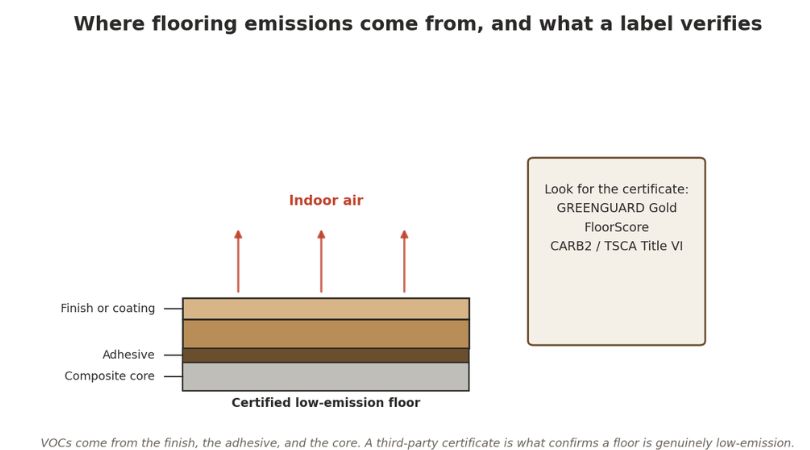
Marketing language like “eco” and “green” is unregulated and means nothing on its own. What means something is a third-party emissions certification. These are the labels to look for.
| Certification | Certification Body | What It Verifies | Commonly Found On |
|---|---|---|---|
| GREENGUARD Gold | UL Solutions | Verifies low chemical emissions and tests products against strict indoor air quality standards, including requirements suitable for schools and healthcare facilities. | Hardwood flooring, laminate flooring, and selected resilient flooring products. |
| FloorScore | SCS Global Services | Certifies low VOC (volatile organic compound) emissions from hard surface flooring materials and flooring adhesives. | Luxury vinyl, SPC flooring, laminate flooring, and ceramic or porcelain tile. |
| CARB2 / TSCA Title VI | California Air Resources Board (CARB) / U.S. EPA | Confirms that composite wood products meet strict formaldehyde emission limits established by U.S. regulations. | Engineered hardwood flooring and laminate flooring with composite wood cores. |
| Declare / Red List Free | International Living Future Institute (ILFI) | Provides full ingredient transparency and verifies products are free from the industry’s most concerning “Red List” chemicals. | Premium flooring collections and environmentally focused product lines. |
Ask for the certificate, not the claim. A reputable retailer can show you the emissions certification for any product on the floor. If nobody can produce one, treat the “low-VOC” label as decoration. The UL GREENGUARD program publishes what its Gold level requires, and it is a genuine bar.
Ranking the materials for air quality
No single material wins outright, because emissions depend on the specific product and its certification. That said, the categories do sort into a rough order for a health-focused buyer.
| Flooring Material | Emissions Risk | Allergen Behavior | Best Choice for a Healthy Home |
|---|---|---|---|
| Porcelain Tile | Very Low (Inert) | Sheds allergens and is easy to clean. | Excellent long-term option. Although hard and cool underfoot, it is chemically inert and highly durable. |
| Solid Hardwood | Low
With the right finish
|
Does not trap dust or allergens. | Choose products finished with low-VOC or water-based coatings for the healthiest indoor air. |
| Engineered Hardwood | Low
If CARB2 certified
|
Sheds allergens like solid wood. | Verify the plywood or HDF core carries CARB2 and other low-emission certifications. |
| Cork | Low | Naturally hypoallergenic and resistant to mould. | Use products installed with low-VOC adhesives and finished with low-emission coatings. |
| SPC Vinyl | Low
FloorScore Certified
|
Waterproof surface prevents allergen buildup. | Look for trusted certifications such as FloorScore—the certification matters more than the material alone. |
| Laminate | Low to Moderate | Does not trap allergens on the surface. | Select laminate with a certified low-emission core (CARB2, FloorScore, or equivalent). |
| Wall-to-Wall Carpet | Low
If certified
|
Can trap dust, pet dander, pollen, and mould. | Indoor air concerns are usually caused by allergen accumulation rather than VOC emissions. |
The pattern is clear. Any hard, sealed, certified floor is a strong air-quality choice. The real outlier is broadloom carpet, which is often fine on emissions but works as a reservoir for everything you are trying to remove from the air.
The allergy problem carpet creates
If someone in the house has asthma or allergies, the flooring conversation changes. Carpet fibres hold dust mites, pet dander, pollen, and mould spores, and vacuuming removes only the surface layer. Every footstep then lifts a little of that reservoir back into the air.
Hard floors do the opposite. Dust and dander sit on top of a smooth surface where a damp mop or vacuum removes them for good. Allergists frequently recommend replacing carpet with hard flooring in the bedroom of an allergy sufferer for exactly this reason. I have walked more than one Saint-Jerome family through swapping bedroom carpet for a low-VOC engineered hardwood after a child’s asthma diagnosis, and the feedback is consistent.
Cork and the mould question
Cork deserves a specific mention because it behaves differently from other soft-feeling floors. It is naturally hypoallergenic and contains a waxy compound called suberin that resists mould, mildew, and insects. That makes it a genuine option for a bedroom where you want warmth and give underfoot without the allergen load of carpet.
The catch is the same as with any product: the health benefit depends on the adhesive and finish. Choose a low-VOC glue for glue-down cork and a low-VOC top coat, and ask for the certifications. Get those right and cork is one of the few soft, quiet, allergy-friendly floors on the market.
Finishes: where hardwood air quality is won or lost
With hardwood, the wood itself is inert. The finish is where the emissions live, and you have a real choice. Oil-based polyurethane is durable and ambers to a warm tone, but it is higher in VOCs and off-gasses a strong smell for days during curing. Water-based finishes are lower in VOCs, dry faster, stay clear, and let you back into the room sooner.
For a family that will be living in the house through the finishing process, especially in winter when you cannot open the windows, a low-VOC water-based finish is usually worth the premium. Factory-prefinished hardwood is another low-emission route, because the finish is cured in a controlled plant and arrives fully off-gassed. Our hardwood flooring page lists the prefinished lines we carry.
The Quebec winter multiplier
Everything about indoor air quality intensifies in a Quebec winter. From roughly November to April the house is sealed and the same air recirculates. A floor that off-gasses, or a carpet that harbours allergens, has months of uninterrupted contact with the air you breathe.
Two moves make a real difference. First, choose certified low-emission flooring so there is little to off-gas in the first place. Second, manage ventilation and humidity. A heat recovery ventilator, or HRV, exchanges stale indoor air for fresh without dumping your heat, and holding indoor humidity in the 35 to 55 percent range that the Canada Mortgage and Housing Corporation recommends keeps mould in check while protecting wood floors from winter gapping. Our cold climate flooring guide covers the humidity side in depth.
Installation choices that affect emissions
The product is only part of the story. How it goes down changes what ends up in your air.
- Adhesive matters as much as the floor. A certified low-VOC floor installed with a high-VOC glue undoes the benefit. Ask for a low-emission adhesive, and confirm it is rated for your material.
- Floating floors use no field adhesive, which sidesteps the glue question entirely, though the planks themselves still need to be certified.
- Acclimate and ventilate. Let a new floor acclimate in the room, and run ventilation during and for several days after installation, when emissions peak.
- Prefinished over site-finished removes the on-site finishing fumes altogether, a real advantage in an occupied winter home.
Our installation services page covers how we handle adhesives and acclimation, which is where a healthy install is made or lost.
A simple decision framework
If air quality is your priority, the choice narrows quickly. For the lowest emissions and easiest cleaning, porcelain tile or a certified hard floor wins. For warmth and comfort without the allergen load, cork or a low-VOC engineered hardwood is the pick. For a bedroom belonging to an allergy sufferer, almost any sealed hard floor beats the carpet it replaces. The one rule that ties it together: buy on certification, not on marketing.
The honest word from the showroom
“People ask me for the healthiest floor as if it is one product, and it is really one habit,” says Sefi Dollinger, Owner of Planchers Bellefeuille, serving Quebec homeowners since 1983. “Ask to see the emissions certificate. A good engineered floor, a certified vinyl, a real hardwood with a water-based finish, they are all quiet on your air if the paper backs it up. The floors that cause trouble are the no-name bargains with no certification and the wall-to-wall carpet nobody has deep-cleaned in ten years. Buy the certificate and you have bought clean air.”
Frequently asked questions
1. What is the healthiest flooring for indoor air quality?
Porcelain tile is the most inert, followed by solid or engineered hardwood with a low-VOC finish and FloorScore or GREENGUARD Gold certified resilient flooring. All are hard, sealed, and easy to keep free of allergens. Certification is what confirms the claim.
2. What are VOCs in flooring?
Volatile organic compounds are chemicals that evaporate into the air from finishes, adhesives, and composite-wood cores. They are highest when a floor is new and decline over time. Certified low-emission products keep them minimal from day one.
3. Is vinyl plank flooring toxic?
Not if it is certified. FloorScore-certified SPC vinyl meets strict low-emission limits. Uncertified bargain vinyl is the concern, because you have no verification of what it releases. Always ask for the FloorScore certificate.
4. Is laminate flooring bad for air quality?
It depends entirely on the core. Laminate uses a fibreboard core that can contain formaldehyde-based resin, so insist on CARB2 or TSCA Title VI compliance and a GREENGUARD certification. Certified laminate is a low-emission floor.
5. What flooring is best for allergies?
Any hard, smooth, sealed floor, because it does not trap allergens the way carpet does. Hardwood, cork, tile, and certified vinyl all let you remove dust and dander with a damp mop. Cork adds natural mould resistance.
6. Is hardwood flooring good for asthma?
Yes. Hardwood does not hold dust mites, dander, or pollen, and it cleans easily, which reduces airborne allergens. Pair it with a low-VOC water-based finish so the finishing process itself does not affect air quality.
6. What does GREENGUARD Gold mean?
It is a UL certification confirming a product meets strict chemical-emission limits, including thresholds set for sensitive environments like schools and healthcare. On flooring it signals genuinely low VOC emissions verified by a third party.
7. What is FloorScore certification?
FloorScore is an SCS Global Services program that tests hard-surface flooring and adhesives against strict VOC emission criteria. It is the most common credible low-emission certification you will see on vinyl, SPC, laminate, and tile.
8. Does new flooring smell go away?
The off-gassing smell from a new floor fades over days to a few weeks as emissions decline. A certified low-emission floor produces little odour to begin with. Ventilate well during and after installation to speed the process.
9. Is cork flooring good for allergies?
Yes. Cork is naturally hypoallergenic and resists mould, mildew, and dust mites, and it does not trap allergens like carpet. Choose low-VOC adhesive and finish to keep the whole installation low-emission.
10. Should I use a water-based or oil-based finish for air quality?
Water-based, if air quality is the priority. It is lower in VOCs, dries faster, and lets you reoccupy the room sooner. Oil-based finishes are durable but release more fumes during curing, which matters in a sealed winter home.
11. How do I improve air quality with the flooring I already have?
Deep-clean or replace old carpet, damp-mop hard floors regularly to remove settled dust, run an HRV to bring in fresh air, and hold indoor humidity between 35 and 55 percent to limit mould and dust mites through the winter.
12. Does carpet cause poor indoor air quality?
Carpet is usually low in emissions if certified, but it traps dust, dander, pollen, and mould in its fibres, and each step releases some back into the air. For an allergy sufferer, replacing bedroom carpet with a hard floor is a common and effective step.