Cork flooring is one of the warmest and quietest surfaces you can install in a Quebec home, and almost nobody considers it. It comes from the bark of the cork oak, it cushions every step, and it dampens sound better than wood, laminate, or tile. In exchange, cork dents, fades in direct sun, and needs resealing. In the right room, it is hard to beat.
What Cork Flooring Actually Is?
Cork comes from the bark of the cork oak, a tree that grows mainly in Portugal and Spain. The bark is harvested by hand every nine years, and the tree lives on and regrows it. It is one of the few genuinely renewable hard-flooring materials, a point the Portuguese Cork Association documents in detail.
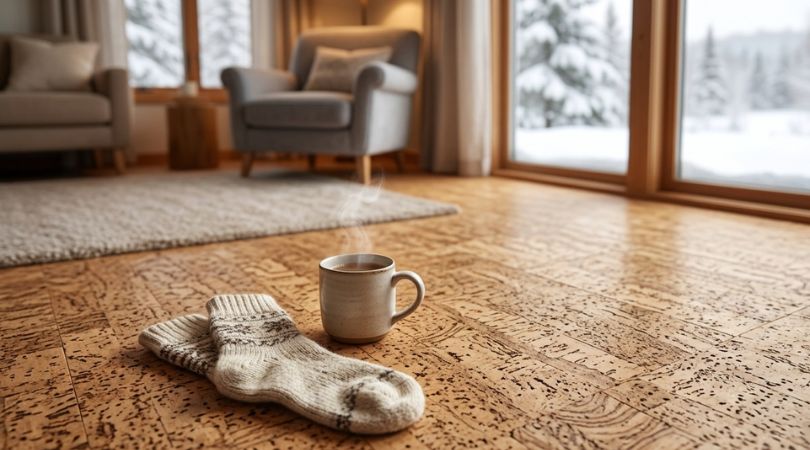
The bark is ground, compressed, and baked into planks or tiles. Millions of sealed air cells give cork its two defining traits: it springs back under pressure, and it insulates. Those same cells are why a cork floor stays warm on a January morning when tile feels like an ice rink. You are literally walking on a layer of trapped air.
How Cork Flooring Is Built?
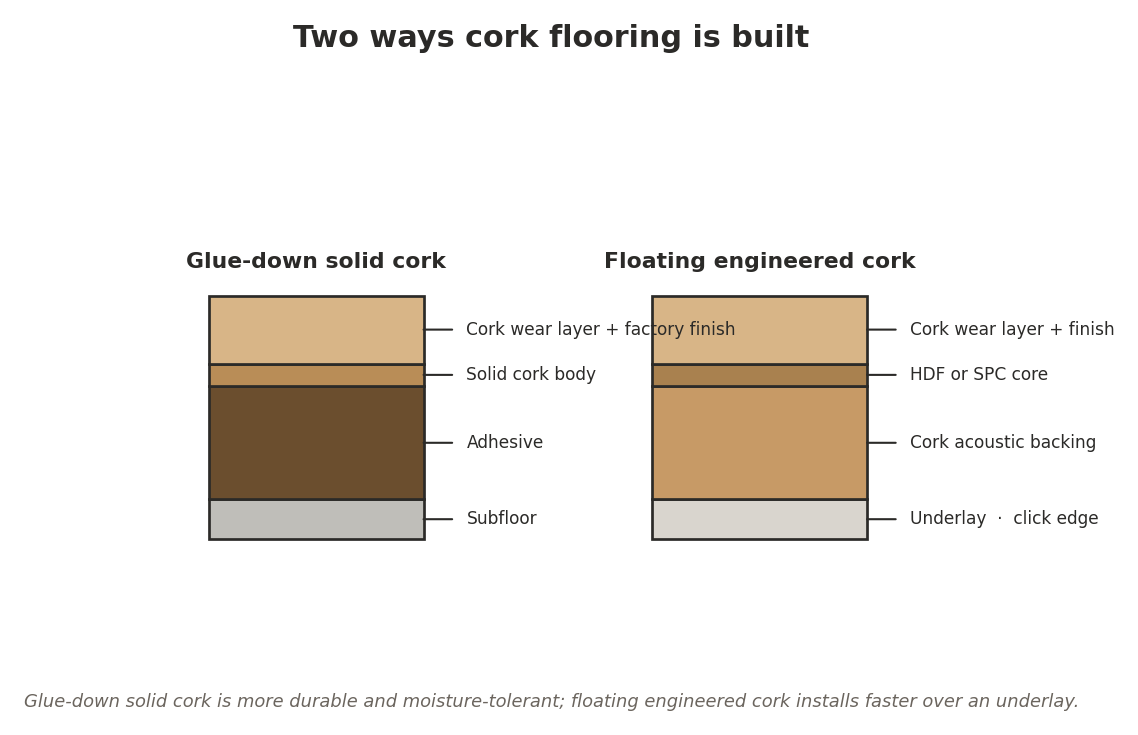
Not all cork is the same product, and the construction decides how it installs, how it wears, and how it handles moisture. There are two main types on the market.
Solid cork tiles are cork all the way through, usually glued down to the subfloor. This is the traditional format. Because it is homogeneous, a solid cork tile can often be sanded and resealed, and it bonds directly to the floor with no hollow sound. Glue-down solid cork is the most durable and the most moisture-tolerant format.
Engineered cork planks, sometimes called floating cork, sandwich a cork wear layer and a cork backing around an HDF or SPC core, with a click-lock edge. This is the format most people picture, and it installs like a laminate over an underlay. It is faster to install and easier for a DIYer, but the HDF core is moisture-sensitive, so the newer SPC-core cork is the better choice for a basement or a damp room.
A newer category worth knowing is the printed cork or cork-backed plank, where a photographic layer sits over a cork base to mimic wood or stone while keeping cork’s acoustic backing. It gives you the quiet and the give of cork with a different surface look.
Finishes And The Surface Layer
The finish is what separates cork from daily life, and there are two common approaches. A factory polyurethane finish is the most durable and lowest-maintenance, sealing the surface against spills and needing only an occasional recoat. An oil-wax or hardwax-oil finish gives a more natural matte look and can be spot-repaired, but it needs more frequent upkeep and is less spill-tolerant.
For a busy Quebec household, I steer people toward a quality factory polyurethane. It handles the reality of a home better, and the small loss in that hand-rubbed matte character is worth it for the durability. Ask what the top coat is before you buy, because it drives your maintenance for the life of the floor.
Why Cork Changes Everything Underfoot?
Walk on a cork floor in socks and you feel it right away. There is a slight softness, the kind your knees and back notice after a long day standing at the kitchen counter. I steer clients toward cork for exactly this reason when they spend hours on their feet at home.
The sound difference is just as real. Cork absorbs impact instead of reflecting it, so footsteps, dropped toys, and dog claws go quiet. In a two-storey home or a condo, that matters. Cork in an upstairs playroom stops the noise from raining down on the room below. No other hard floor does this as well without an added underlayment. If sound is a priority for you, this is cork’s headline advantage.
Cork And Indoor Air Quality
Cork earns attention beyond comfort, and indoor air quality is part of the story, especially through a long Quebec winter when the house is sealed tight for months. Cork is naturally hypoallergenic and resists mould, mildew, and dust mites, because its cellular structure does not trap allergens the way carpet does. That makes it a strong choice for a bedroom belonging to someone with allergies or asthma.
Two caveats keep this honest. First, the air-quality benefit depends on the adhesive and finish, so choose a low-VOC glue for glue-down cork and a low-VOC top coat, and ask for the certifications. Second, cork also contains a naturally occurring waxy substance called suberin that resists insects and mould, which is a genuine property, not a marketing line. Ventilate well during and just after installation regardless, as any new floor and its adhesives off-gas most in the first days.
How Cork Handles A Quebec Winter?
This is where cork surprises people. A Quebec winter drops indoor humidity hard. Once the furnace has run for a few months, the air can fall below the 30 to 50 percent range that the Canada Mortgage and Housing Corporation recommends for a healthy home. Solid hardwood shrinks and cracks in that dry air. Cork moves far less.
Because cork is a compressed, homogeneous material rather than long solid boards, it expands and contracts modestly and evenly. On our showroom floor in Saint-Jerome, cork samples kept through six winters show no opening. That stability, paired with its natural insulation, makes it a genuinely good fit for our climate. Keep a hygrometer in the room and hold humidity in the 35 to 55 percent band, and the floor stays flat and tight.
Radiant Heating Compatibility
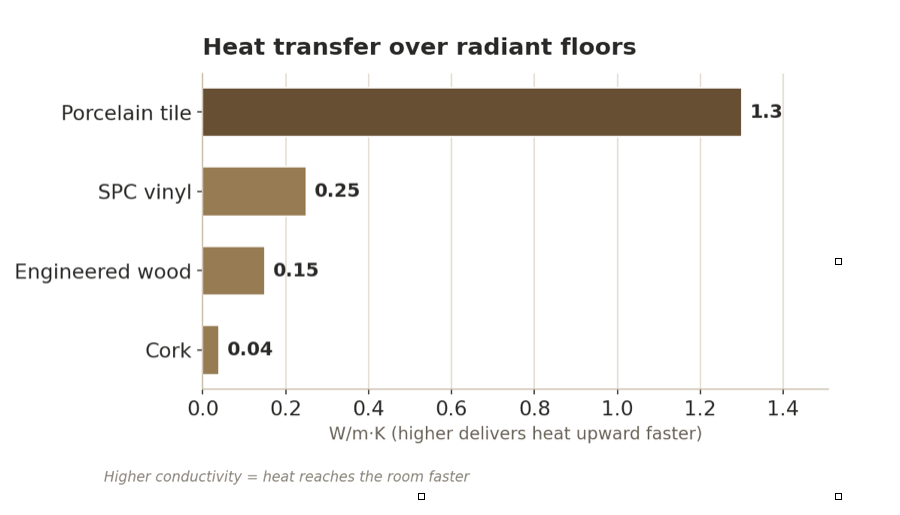
Cork works over radiant heat, with one honest tradeoff. Glued-down cork is the format to use over radiant, and it must be a product the manufacturer approves for it. The catch is that cork insulates, which is exactly what makes it warm underfoot but also what makes it a slower conductor of radiant heat. The room warms more gradually and the system runs a little harder to push heat through.
For a bedroom, where the temperature holds steady and comfort at 6 a.m. matters more than fast response, cork over radiant is lovely. For a bathroom where you want quick, responsive heat, porcelain is the better partner. Match the format to the room, respect the manufacturer’s surface temperature limit, and use a radiant-rated adhesive. Our engineered hardwood page and the wider radiant discussion cover how different materials behave over in-floor heat.
Installation: Floating Versus Glue-down
How cork goes down matters as much as which cork you buy, and the two methods suit different situations.
Glue-down bonds solid cork tiles or planks directly to a clean, flat, dry subfloor with a recommended adhesive. It is the more durable, more moisture-tolerant, and quieter method, with no hollow sound underfoot, and it is the right choice over radiant heat and in damper rooms. The tradeoff is that it demands a very flat subfloor and more skill to install, so it is usually a professional job.
Floating click-lock cork planks lay over a thin underlay with no glue, expanding and contracting as a single field with a small perimeter gap. It is faster, DIY-friendly, and easily lifted later. The tradeoffs are a slightly hollower sound, more sensitivity to standing water at the seams if the core is HDF, and the need for a genuinely flat subfloor to keep the locking joints from working loose.
For a Quebec basement or any room where moisture is a possibility, I recommend glue-down solid cork or a floating plank with an SPC core, never a floating HDF-core product. Subfloor flatness is the detail that most often decides whether a cork installation succeeds. Our installation services page covers the subfloor prep that makes or breaks the result.
The Best Rooms For Cork
Cork is a specialty floor, not a whole-house floor. It earns its place in specific rooms.
- Bedrooms: warm and quiet, the two things you want underfoot at 6 a.m.
- Home offices: the sound damping keeps the room calm, and the cushion helps if you work standing.
- Playrooms and nurseries: soft landings, quiet play, and a forgiving surface for dropped blocks.
- Reading nooks and hobby rooms: anywhere comfort and quiet matter more than raw toughness.
I rarely recommend cork for a busy entry, a kitchen with a big dog, or a full bathroom. There are better tools for those jobs, and part of my job is saying so.
Cork Compared To The Alternatives
The fairest way to judge cork is against the floors people cross-shop it with. Here is how it stacks up on the factors that actually drive the decision.
| Factor | Cork | Hardwood | SPC vinyl | Laminate | Porcelain tile | Carpet |
|---|---|---|---|---|---|---|
| Warmth underfoot | Excellent | Good | Good | Fair | Poor without radiant | Excellent |
| Sound absorption | Excellent | Fair | Good | Poor | Poor | Excellent |
| Comfort and give | Excellent | Firm | Slight | Firm | Hard | Soft |
| Water resistance | Fair, needs sealing | Poor | Waterproof | Water-resistant | Waterproof | Poor |
| Scratch and dent | Dents easily | Scratches, dents | Scratch-resistant | Scratch-resistant | Excellent | Stains |
| Refinishing | Solid cork only | Yes, many times | No | No | No | No |
| Sustainability | Excellent, renewable | Good | Poor | Fair | Fair | Poor |
| Best suited to | Bedrooms, offices | Living areas | Wet rooms, basements | Budget rooms | Wet rooms, entries | Bedrooms |
Cork’s clear wins are warmth, quiet, comfort, and sustainability. Its clear losses are water resistance and dent resistance. Read the table by what you value most in the specific room, not as an overall scorecard.
The Limits, Honestly
No floor is perfect, and cork has three real weaknesses. Here they are without sales gloss.
| Issue | What Actually Happens | How to Manage It |
|---|---|---|
| Dents | Heavy furniture legs and dropped knives can leave marks. Cork recovers from light pressure but not from sharp impacts. | Use wide furniture pads and choose a denser floating click cork floor for high-traffic rooms. |
| Water | Standing water can cause seams to swell if left too long. Cork is water-resistant, not waterproof. | Wipe up spills promptly and avoid installing cork in full bathrooms or laundry rooms unless using sealed glue-down tiles. |
| Sun Fading | Direct sunlight can fade cork more quickly than most hardwoods, often creating uneven color changes. | Install blinds or UV window film on south-facing windows and rotate rugs periodically for even aging. |
Being straight about this is the difference between a happy client in year five and a callback.
Sealing and Maintenance
Most cork arrives with a factory finish, often a polyurethane or an oil-wax. That finish is what stands between the cork and daily life, and it wears. Plan to refresh the top coat every five to seven years in a lived-in room, sooner in a busy one. A recoat is a light abrasion and a fresh coat of finish, far less involved than a full sanding, and it resets the floor’s protection.
Day to day, cork is easy. Sweep or vacuum with a soft head, mop with a barely damp cloth, and skip the steam mop, which drives moisture into the seams. Felt pads under every chair and a mat at the door handle 90 percent of the wear before it starts. Solid glue-down cork can be sanded and resealed if it is ever badly worn, a renewal option that floating engineered cork does not offer.
Cork Versus The Other Soft, Quiet Floors
If comfort and quiet are your goals, cork has two main rivals: luxury vinyl with a built-in cushion, and carpet. Cork beats carpet on cleaning and allergens, and beats vinyl on warmth and renewability. Vinyl wins on waterproofing, carpet wins on price. For a bedroom or office where you want a natural material that stays warm all winter, cork is often the right answer. Our luxury vinyl page shows the cushioned SPC options if waterproofing outranks natural material for you, and our cold climate flooring guide explains how each material behaves when the temperature drops.
A Cork Project From The Showroom
A client in Prevost with a home office over an unheated garage came in complaining the room was cold and echoey on a laminate floor. We put down glue-down solid cork with a low-VOC adhesive. The change was immediate: the floor reads warm underfoot even with the garage cold below, and the room went quiet enough that video calls stopped picking up the echo. Two winters on, no gapping, no complaints. That is the room cork is built for.
Is Cork Right For Your Home?
“Cork is the floor people fall in love with in the showroom without expecting to,” says Sefi Dollinger, Owner of Planchers Bellefeuille, serving Quebec homeowners since 1983. “They step on it, feel the warmth and the give, and the conversation changes. My one rule is honesty about where it belongs. Put it in a bedroom or office and it becomes the calmest room in the house. Put it in a splash-filled kitchen and you will be disappointed. Match the floor to the room and cork rarely lets you down.”
If you want warmth, quiet, and a renewable material in a room where toughness is not the priority, cork deserves a real look. Come feel the samples yourself. Browse our full flooring range to compare cork against the alternatives in person.
Frequently Asked Questions
Is cork flooring good for Quebec winters?
Yes. Cork is a compressed, homogeneous material that moves far less than solid hardwood in dry winter air, and its cellular structure insulates so it stays warm underfoot. Keep indoor humidity between 35 and 55 percent for best results.
Does cork flooring dent easily?
Cork recovers from light pressure but takes permanent marks from sharp or heavy point loads like furniture legs and dropped knives. Use wide furniture pads and choose a denser product for harder-used rooms.
Is cork flooring waterproof?
No, cork is water-resistant, not waterproof. It handles spills wiped up promptly, but standing water can swell the seams. For wet rooms, use sealed glue-down cork tile or choose a different material.
How long does cork flooring last?
A well-maintained cork floor lasts 20 to 30 years or more. Solid glue-down cork can be sanded and resealed to extend its life further, while floating engineered cork is replaced rather than refinished.
Can cork flooring be installed over radiant heat?
Yes, glued-down cork approved for radiant use works over in-floor heat. Because cork insulates, the room heats more slowly and the system runs a little harder, so cork suits bedrooms better than fast-response rooms like bathrooms.
Is cork flooring good for soundproofing?
Cork is one of the best hard-surface floors for sound absorption. It dampens footsteps and impact noise, making it ideal for upstairs rooms, condos, and home offices where quiet matters.
How do you maintain cork flooring?
Sweep or vacuum with a soft head, damp mop with a barely wet cloth, and avoid steam mops. Use felt pads under furniture, and plan to recoat the finish every five to seven years in a lived-in room.
What rooms are best for cork flooring?
Bedrooms, home offices, playrooms, nurseries, and reading nooks, where warmth, quiet, and comfort matter most. Cork is not ideal for busy entries, kitchens with large dogs, or full bathrooms.
Is cork flooring environmentally friendly?
Yes. Cork is harvested from the bark of living cork oaks every nine years without felling the tree, making it one of the few genuinely renewable hard-flooring materials.
Floating or glue-down cork, which is better?
Glue-down is more durable, quieter, more moisture-tolerant, and the right choice over radiant heat, but needs a very flat subfloor and professional installation. Floating click-lock cork is faster and DIY-friendly but slightly hollower and more seam-sensitive if the core is HDF.
Is cork flooring good for allergies?
Yes. Cork is naturally hypoallergenic and resists mould, mildew, and dust mites, and it does not trap allergens the way carpet does. Choose low-VOC adhesive and finish to maximize the indoor air-quality benefit.
Does cork flooring fade in sunlight?
Yes, cork fades faster than most woods in direct sun, and often unevenly. Use blinds or UV film on south-facing windows, and rotate area rugs so the floor ages evenly.