Stairs are the most demanding surface in any home. Every single step lands hard on the front edge, your foot rotates slightly as it pushes off, and a slip there sends someone to the hospital, not back to bed. The best flooring for stairs is solid hardwood or thick-veneer engineered hardwood with a factory-finished edge, installed by someone who specializes in stair systems. Vinyl and laminate work in some situations, but they come with trade-offs most homeowners don’t see until year three.
Why Stairs Aren’t Just “The Floor At an Angle”
Three things separate stair flooring from regular floor flooring. First, the impact. A 170-pound adult coming down stairs lands the front edge of each step with about 1.5 times their body weight. Over years, that force at the leading edge wears down the finish faster than anywhere else in the house.
Second, the twist. Each step rotates a little as the foot lands and pushes off. That twist grinds the finish in a different pattern than walking on a flat floor, which is why stair treads dull and scratch quicker than the hallway they connect to.
Third, the building code. Stair dimensions are set by the Quebec construction code and the National Building Code of Canada. If a renovation breaks the code, it can affect your insurance and the resale of your home.
Safety First
Grip When Wet or in Socks
Every flooring product has a slip-resistance score. For stairs, you want a matte (not glossy) finish and a score noticeably above the minimum. Polished surfaces are a real hazard, especially with socks or slippers.
If you fall in love with a smoother material, there are ways to add grip: factory anti-slip strips on the front edge, retrofit aluminum strips with a rubber insert, or a non-slip additive mixed into the top coat for site-finished wood.
Seeing the Step
Stairs are easier and safer when the edge of each step visually separates from the rest of the tread. A contrasting nosing colour, a small built-in LED light at the front, or a non-slip strip in a different shade all help. This matters most for older adults, kids, and anyone carrying laundry or boxes who can’t see their feet clearly.
Code Basics
A few things the Quebec construction code requires you to keep in mind during a renovation:
- Step height (riser): uniform, between 125 and 200 mm (5 to almost 8 inches).
- Step depth (tread): at least 235 mm (9 1/4 inches).
- The front edge: projects 15 to 25 mm (5/8 to 1 inch) past the riser.
- Variation: less than 5 mm difference between any two steps in the same staircase.
A renovation that adds thick flooring on top of stairs without adjusting the riser heights can pull the staircase out of code compliance. Most prefinished hardwood treads (around 3/4 to 1 inch thick) keep things compliant, but stacking thick luxury vinyl on top of an existing stair tread sometimes doesn’t. Measure first.
What “Durable Enough” Means for Stairs
The front edge of every stair is where flooring earns or doesn’t earn its warranty. What I look for:
- For engineered hardwood: a real-wood top layer at least 4 mm thick. Thinner than that, and the leading edge wears down to the layer underneath within 10 to 15 years.
- For luxury vinyl: a top coat of at least 28 mil. Less, and it scratches through to the printed layer at the front edge.
- The finish: factory-baked finishes hold up two to three times longer on stairs than ones applied on-site.
- The wood species (for solid hardwood): harder is better. White oak, hard maple, and hickory all work. Red oak is okay for moderate use but I steer clients away from it for the busiest stairways.
- The front-edge piece: should be a solid milled piece of the same wood as the rest of the step, never a separate strip glued to the edge.
Best Materials for Stairs
Solid Hardwood
The gold standard. A solid wood tread (3/4 or 1 inch thick) in white oak, hard maple, or hickory, with a milled front edge and a factory-baked finish, will last the life of the home with the occasional refinish. The visual continuity with your hallway hardwood is unmatched. The downside is cost. Plan on $180 to $320 per step installed for solid hardwood.
Engineered Hardwood
Engineered hardwood with a 4 mm or thicker top veneer is what I recommend most often for Quebec homes. It looks identical to solid hardwood, costs about 25% less, and stays more stable when the air swings from humid summer to dry winter. That matters on staircases that go between humidity zones (basement to main floor, garage entry to mudroom). Manufacturers like TORLYS pair their treads with matching factory-finished front edges, so the system goes in as a complete kit. For more on the difference, our hardwood vs engineered guide walks through the lifetime cost.
Luxury Vinyl Plank
Vinyl on stairs is trickier than on a floor. The plank has to either be cut around a stair nosing, or paired with a matching nosing piece from the same manufacturer. Many homeowners try a DIY install with a generic nosing, and within two years it separates from the tread, leaving an exposed edge that can catch a foot. For vinyl stairs, only use a manufacturer-matched system, glued down (not floating), with a 28 mil top coat or thicker. The rigid-core kind (often called SPC) handles stairs better than the more flexible kind (WPC).
Laminate
Laminate on stairs is the riskiest of the four. It can work, but only with strict rules. AC4 rating or better, a manufacturer-matched nosing piece, glued down (not stapled), and never on a stair that leads from an exterior entry. The most common failure I see is laminate steps that swell at the front edge after a winter of wet boots. If your stairs connect a front entry to your main living level, choose hardwood or engineered before laminate.
Keeping Your Stairs Visually Connected to Your Floors
Stairs anchor a home visually. A staircase that matches the hallway flooring feels intentional. One that doesn’t match feels like a compromise.
The rules I give clients:
- Same wood species and stain. If the hallway is white oak in a matte finish, the stair treads should be too.
- Match the plank width visually. Wide-plank hallways (6 or 7 inches) look best with stair treads made as a single piece, not several narrow boards joined together.
- Risers should fade into the background. Painted risers in soft white or your trim colour highlight the tread and create a cleaner stair line.
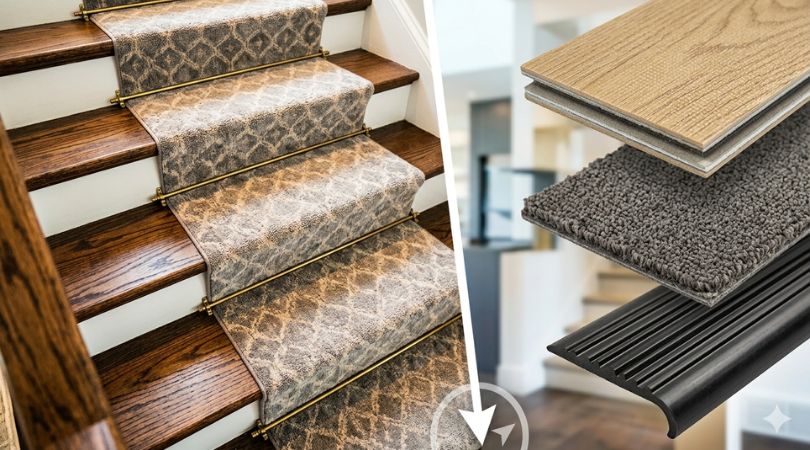
- Think about a runner. If a carpet runner will go down the centre, the exposed wood on either side becomes the focal surface. Pick a material that holds up to direct foot traffic on those edges.
For more on the structural choice between building stairs custom versus buying them prefabricated, our post on custom stairs vs prefabricated stairs covers the trade-offs.
Comparison at a Glance
| Material | Grip when dry | How tough it is | How well it handles Quebec winter | Realistic stair lifespan | Cost per step installed |
| Solid white oak | Good (matte finish) | Very hard | Excellent | 50+ years (refinished) | $220 to $320 |
| Engineered hardwood, 4 mm+ top | Good (matte finish) | Hard surface | Excellent | 30 to 50 years | $180 to $260 |
| TORLYS engineered with sealed joints | Good (matte finish) | Hard surface | Excellent | 30 to 40 years | $190 to $270 |
| Rigid-core luxury vinyl, 28 mil, glued | Good to very good | Commercial-grade top coat | Very good | 15 to 25 years | $130 to $200 |
| AC4 laminate, glued | Okay to good | Light commercial-grade | Okay (avoid wet areas) | 10 to 15 years | $110 to $170 |
| Carpet runner over wood tread | Depends on the carpet | Material-dependent | Excellent | 8 to 15 years (carpet) | $90 to $180 |
Prices are realistic ranges for Greater Montreal and the Laurentians in 2026, assuming professional installation.
The Details Most Homeowners Miss
The front edge of each step (called the nosing) is the single most important detail on any stair install. It takes the impact every time. It defines the visual edge. And it’s what determines whether the stair meets code.
Three rules I never break:
- The nosing has to be the same material as the rest of the step. A solid wood tread should have a milled solid wood nosing. An engineered tread should have its matching engineered nosing. Mixing materials creates an early failure point.
- The nosing needs a factory-baked finish. Field-finished nosings dull and fail faster. Factory finishes from manufacturers like TORLYS outlast field-applied finishes by about two to one.
- The joint where the step meets the riser should be sealed with a flexible caulk. Stairs flex slightly underfoot. Rigid caulk cracks. A colour-matched flexible caulk handles the movement and keeps moisture and grit out.
Stair skirting (the trim against the wall), stringers (the side pieces on an open staircase), and any decorative trim should be installed and finished before the treads go in. Doing it in the wrong order creates seams that fail within a couple of seasons.
“The detail that separates a stair install I’m proud of from one I’m not is the factory-finished nosing and the flexible caulk at the tread-riser joint,” says Sefi Dollinger, Owner of Planchers Bellefeuille, serving Quebec homeowners since 1983. “Everything else flows from those two.”
Why Stairs Aren’t a Good DIY Project
The two riskiest DIY flooring projects in a home are showers and stairs. Both fail in expensive, sometimes dangerous ways when done wrong.
Stair installs specifically require:
- Measuring every step (in older Quebec homes, no two are usually exactly the same).
- Hitting the code tolerances on each step.
- Picking the right adhesive for the type of subfloor (wood, plywood, or concrete cap).
- Fastening the right way (face-nailed and glued, or screwed from below depending on the system).
- Aligning every nosing to within 1 mm across the whole staircase.
Mistakes here show up as squeaks, uneven edges, splitting, or loose treads within the first year. Replacement of a failed DIY install often costs more than the original professional quote would have.
FAQs
What’s the Safest Flooring for Stairs?
Solid or engineered hardwood with a matte factory finish and a contrasting nosing offers the best mix of grip and visibility. A carpet runner over a hardwood tread is also a strong safety choice for households with young children or older adults.
Can I Install Laminate on My Stairs?
Yes, but only with a manufacturer-matched nosing piece, glued (not floating), an AC4 rating or higher, and not on stairs leading from an outside entrance. Laminate has the shortest stair lifespan of the major materials.
How Much Does It Cost to Install Hardwood Stairs in Quebec?
Engineered hardwood typically runs $180 to $260 per step installed, including the tread, riser, nosing, and labour. Solid hardwood runs $220 to $320 per step. Open-riser and curved staircases cost more.
Are Open-Riser Stairs Less Safe?
They meet code in most places, but they have specific tread depth and railing requirements. They look more open visually, but they’re harder for some people, especially anyone with vertigo or vision issues. Material choice is the same as for closed-riser stairs.
Do Wood Stairs Need Refinishing More Often Than My Hallway Floor?
Yes. Stairs usually need a refresh every 8 to 12 years, compared to 15 to 20 years for hallway hardwood, because of the concentrated wear at each step’s front edge.
Get the Stair Detail Right the First Time
Stair installs are the part of our work where small details matter most for safety and looks. Visit our Saint-Jerome showroom to see fully built stair sections in hardwood, engineered, and TORLYS systems, with the nosing-to-tread joinery up close.
Planchers Bellefeuille | 450, boul. Roland-Godard, Saint-Jerome, QC | (450) 431-1643