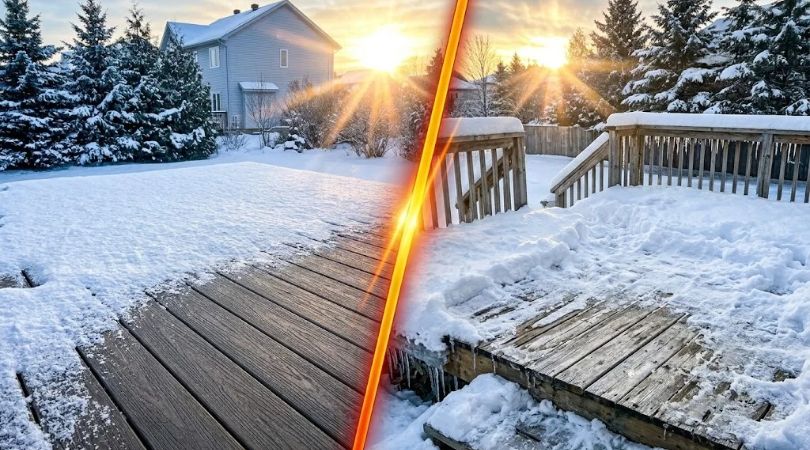

For a wood deck in Quebec, pressure-treated lumber is the budget choice, western red cedar is the natural middle ground, and Accoya is the premium option built to outlast both. All three can survive our winters. They differ in how much rot resistance you buy up front, how much maintenance you owe each year, and how long the deck stays flat and sound.
Not All Decking Wood Is Equal
Homeowners often shop decking by colour and price and assume “wood is wood.” It is not. The three woods below resist water, rot, and insects in completely different ways, and in a climate with five months of snow and dozens of spring freeze-thaw cycles, that difference shows up fast.
Pressure-treated lumber is ordinary softwood made rot-resistant by a chemical treatment. Cedar is naturally rot-resistant because of the oils in the wood itself. Accoya is radiata pine that has been chemically modified all the way through so it behaves like a dense tropical hardwood. Three woods, three strategies, three very different lifespans. Here is how each one earns its place.
Pressure-treated: The Budget Standard
Pressure-treated decking is spruce, pine, or fir forced full of a copper-based preservative under pressure. The treatment makes the wood unappealing to fungi and insects, which is why it is the most common deck board in Canada and the cheapest by a wide margin.
The trade-offs are real. Treated lumber arrives wet, so it shrinks, checks, and sometimes twists as it dries on your deck. It needs sealing once it has dried out and then every year or two after. The copper preservative also corrodes standard fasteners, so you must use hot-dipped galvanized or stainless hardware rated for treated wood. Done right, a pressure-treated deck gives ten to fifteen years in Quebec. It is a sensible choice for a utility deck, a rental, or a budget that has to stretch, as long as you accept the upkeep.
Western Red Cedar: Natural Beauty And Rot Resistance
Cedar resists rot and insects on its own, thanks to natural oils and extractives in the heartwood, with no chemical treatment needed. It is lighter and more stable than treated softwood, so it stays flatter and splits less as it dries. It also smells wonderful and takes a stain beautifully.
Cedar is softer than you might expect, so it dents under dragged furniture and shows wear on stairs. Left unsealed it silvers to a soft grey, which some homeowners love, but the surface fibres then erode faster. Sealed every two to three years, a cedar deck lasts fifteen to twenty-five years here. It costs more than pressure-treated and less than composite, and it is the wood we recommend most for a homeowner who wants the real thing and will look after it.
Accoya: Modified Wood Built For Extreme Weather
Accoya starts as fast-growing radiata pine and goes through acetylation, a process that changes the wood’s cell chemistry so it can no longer absorb water the way natural wood does. The result is a board that barely swells or shrinks, resists rot to the highest durability class, and is warrantied by the manufacturer for 50 years above ground.
We know this material firsthand. We use Accoya on our projects in the Bahamas, including the National Art Gallery of the Bahamas, where salt air, humidity, and sun punish wood harder than a Quebec winter does. It holds paint and stain far longer than natural wood because it is not constantly moving under the finish. The cost is the highest of the three, and it must be fastened with stainless steel, but for a deck you want to build once, it is the strongest answer we can give. Technical data is published by Accoya.
Rot, Warping, And Insects Compared
The table below is the comparison we draw on the counter for customers.
- Property | Pressure-treated | Western red cedar | Accoya
- Rot resistance | Treated layer, cuts need re-treating | Natural, heartwood only | Full depth, highest class
- Dimensional stability | Low, shrinks and twists | Medium | Very high
- Insect resistance | Good while treatment lasts | Good | Excellent
- Expected service life | 10 to 15 years | 15 to 25 years | 50-year above-ground warranty
- Sealing frequency | Every 1 to 2 years | Every 2 to 3 years | Every 5 to 10 years if coated
- Fasteners required | Galvanized or stainless | Stainless recommended | Stainless only
- Relative material cost | Lowest | Mid | Highest
Stability is the row people underrate. A board that does not move does not open gaps for water, does not loosen its screws, and does not crack its finish. That is why the Accoya column reads the way it does.
Sustainability And Finish Options
Cedar from a certified Canadian forest is a renewable, low-energy material, and both cedar and Accoya can carry FSC certification, which tells you the forest was managed responsibly. Accoya’s source pine grows in about 25 years, and the acetylation process uses a compound that leaves no toxic residue, which is why it is often specified on projects with strict environmental targets. Pressure-treated wood is the least appealing here, since the preservative limits how it can be disposed of.
All three take stain and paint, but not equally well. Treated wood must dry for months before it will accept a finish. Cedar takes a penetrating oil or stain beautifully and should be recoated as it weathers. Accoya holds a coating two to three times longer than natural wood because the board underneath stays still. Our guide to eco-friendly flooring covers the same certifications for interior wood.
Why We Build Decks The Way We Build Floors?
“I treat a deck the way I treat a hardwood floor: the material you pick has to match the conditions and the owner,” says Sefi Dollinger, Owner of Planchers Bellefeuille. “Pressure-treated for a deck that just needs to exist, cedar for someone who loves wood and will oil it, and Accoya when a customer says they never want to do this again. We learned what Accoya can take on the Bahamas projects. If it survives salt air on the ocean, a Laurentian winter is not going to bother it.”
Matching The Wood To Your Budget And Exposure
Choose pressure-treated when budget is the deciding factor and you will commit to sealing it, ideally for a lower, partly sheltered deck. Choose cedar for a visible deck where the look of real wood matters and you can seal it every couple of years. Choose Accoya for a large, exposed, or elevated deck, a lakefront property, or any build where you want fifty years without worrying about rot or movement. Whatever you choose, get the structure right first, because joists and footings fail before boards do. See the woods side by side in our decking catalogue, and read our cottage and chalet flooring guide if the deck belongs to a seasonal home.
Frequently Asked Questions
Is cedar or pressure-treated better for a deck?
Cedar is the better material, with natural rot resistance, better stability, and a far nicer look. Pressure-treated is the cheaper material and lasts ten to fifteen years with regular sealing, versus fifteen to twenty-five for cedar. If budget decides, choose treated and seal it. If the deck is visible and you will maintain it, choose cedar.
What is Accoya decking?
Accoya is radiata pine modified through acetylation, a process that changes the wood’s cells so they barely absorb water. The result resists rot to the highest durability class, hardly swells or shrinks, holds finishes much longer, and carries a 50-year above-ground manufacturer warranty. It is the premium option for decks built to last.
How long does a cedar deck last in Quebec?
Fifteen to twenty-five years when it is sealed every two to three years and drains well. Left unsealed, cedar silvers and the surface fibres erode faster, shortening its life. Stairs and high-traffic zones wear first because cedar is a relatively soft wood.
Does pressure-treated wood warp?
Often, yes. Treated lumber is sold wet from the treatment process and shrinks, checks, and sometimes twists as it dries on the deck. Letting the boards acclimate before installation, fastening them properly, and sealing them once dry reduces the movement but does not eliminate it.
Can you stain Accoya?
Yes, and it holds stain and paint two to three times longer than natural wood, because the board underneath does not move with moisture. Accoya can also be left to weather naturally to a silver-grey. Use stainless steel fasteners with it, since the acetylation process makes it corrosive to standard hardware.
Is cedar decking sustainable?
Cedar from a certified Canadian forest is a renewable, low-energy material. Look for FSC certification, which confirms responsible forest management. Accoya can also be FSC-certified and is made from fast-growing pine with a non-toxic process, which is why it is specified on projects with strict environmental targets.
What fasteners should I use on a deck?
It depends on the wood. Pressure-treated needs hot-dipped galvanized or stainless steel rated for treated lumber, because the preservative corrodes standard screws. Cedar is best with stainless to avoid black streaks. Accoya requires stainless steel only. Using the wrong fastener is one of the most common causes of early deck failure.
Which decking wood needs the least maintenance?
Accoya, by a wide margin. A coated Accoya deck can go five to ten years between recoats and never needs rot treatment. Cedar needs sealing every two to three years, and pressure-treated every one to two. If low maintenance is the goal and wood is a must, Accoya is the answer.
Ask to see our Accoya samples next to cedar in Saint-Jerome, and we will size the right wood to your deck and your exposure.
450, boul. Roland-Godard, Saint-Jerome, QC | (450) 431-8789 | planchersbellefeuille.com