A commercial floor in Quebec has to handle a lot more than a floor at home. Hundreds of people walk across it each day. Slush, sand, and salt get tracked in from December through March. And the air inside swings from humid in July to bone-dry in February. Picking the right floor comes down to four simple questions: how many people use it, how much moisture hits it, how easy is it to clean, and how long do you plan to keep it. Get those right and the rest falls into place.
Why So Many Commercial Floors Fail Before Their Warranty Runs Out
Most of the early failures we see at our Saint-Jerome showroom share the same cause: the wrong floor was chosen for how the space actually gets used. A vinyl tile meant for a quiet boutique ends up in a busy coffee shop entryway, and the seams start showing within a year and a half. A thin laminate gets installed in a clinic lobby that staff wet-mop every night, and the joints swell by year two.
The fix happens at the planning stage, not on installation day. Before quoting any project, I ask the business owner four questions. How many people cross this floor each day? Do you have a vestibule with a good entry mat, or does outdoor moisture hit the floor directly? Will it get wet-mopped or just lightly damp-mopped? And are you renovating again in three years, or keeping this for fifteen?
The answers usually rule out about 70% of the catalogue before we even start talking about colour.
Four Things That Shape the Right Answer
Foot Traffic
The industry sorts commercial spaces into three buckets. Light commercial is a small office or private practice with fewer than 100 visitors a day. Moderate commercial is a boutique, a dental clinic, or a small restaurant. Heavy commercial is a grocery store, a big-box retailer, or a hotel lobby. The thicker and tougher the protective top layer of the floor, the more traffic it can take without showing wear.
Safety and Slip Resistance
Quebec winters bring salt, slush, and snowmelt right through the front door. Every floor has a slip-resistance rating, and the higher the number, the better the grip when the surface is wet. The Tile Council of North America sets the safety benchmark we use for any interior commercial space. For an entry that sees winter water, you want a tile or vinyl rated noticeably above that benchmark, especially in the first few metres past the door.
How Much Cleaning it Really Needs
Some floors look cheap until you add up ten years of stripping, waxing, or grout sealing. Sheet vinyl is one of those. Porcelain tile and high-quality luxury vinyl cost a bit more up front but only need a neutral cleaner and water for the long run. If your team is small or your cleaning budget is tight, choose the floor that asks the least of you.
How the Space Should Feel
A commercial floor is part of your brand. A wine bar in the Plateau and a children’s clinic in Laval both need a durable surface, but they’re going for opposite vibes. Pick the performance level first, then choose colour and style within what fits that level. Doing it the other way around is how people end up with a beautiful floor that fails in three years.
The Best Floor for Your Kind of Space
| Type of space | First choice | Why it works | What to avoid |
| Open-plan office | Modular carpet tile | Quiet, easy to replace one square if it’s stained, works with raised-access floors | Broadloom (wall-to-wall) carpet, glue-down vinyl under chair rollers |
| Boutique retail | Porcelain tile or premium luxury vinyl plank | Handles heels, looks great in photos, simple to clean | Engineered hardwood without a commercial-grade top layer |
| Restaurant dining room | Porcelain tile with a strong slip rating | Spilled wine, grease, water all wipe clean, easily lasts 30 years | Bare polished concrete (cracks, oil stains) |
| Hotel lobby | Large-format porcelain at entrances, commercial vinyl in hallways | Photographs beautifully, hides the wear paths | Solid hardwood (luggage and carts will dent it) |
| Medical or dental clinic | Welded sheet vinyl or homogeneous vinyl | Curved base trim means no bacteria-trapping seams, easy to disinfect | Grouted tile (grout is porous) |
| Showroom or light industrial | Polished concrete or a thick rigid-core vinyl | Forklift-safe, stays flat across temperature changes | Floating laminate |
Offices
For private offices and consulting firms, modular carpet tile wins almost every time. We installed about 4,200 sq ft for a Saint-Jerome accounting firm last spring, and after a server-room leak, the staff replaced two damaged tiles themselves using the spare squares we’d left behind. That kind of one-tile fix is the feature you don’t appreciate until you need it.
Retail
In retail, you want the floor to quietly support the product, not compete with it. A large-format porcelain tile with thin grout lines reads almost as one continuous surface, which makes the merchandise pop. If the renovation budget is tight, a long-plank luxury vinyl can give a similar look for about a third of the install cost. If you’re weighing those two formats more broadly, our laminate vs vinyl breakdown walks through the trade-offs in plain language.
Hospitality
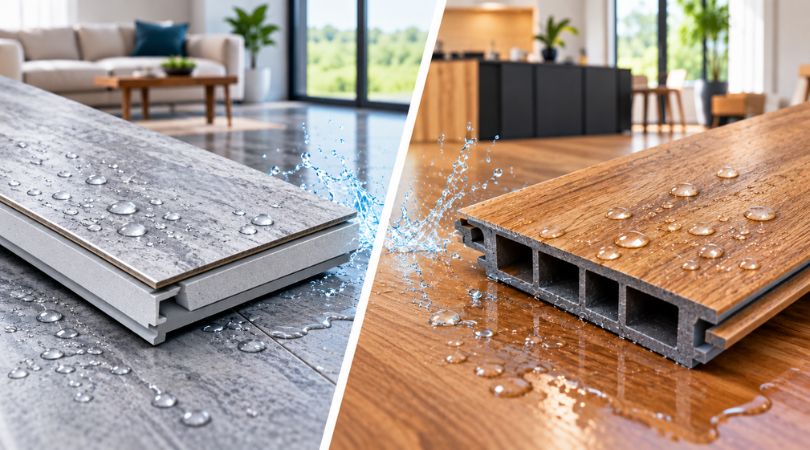
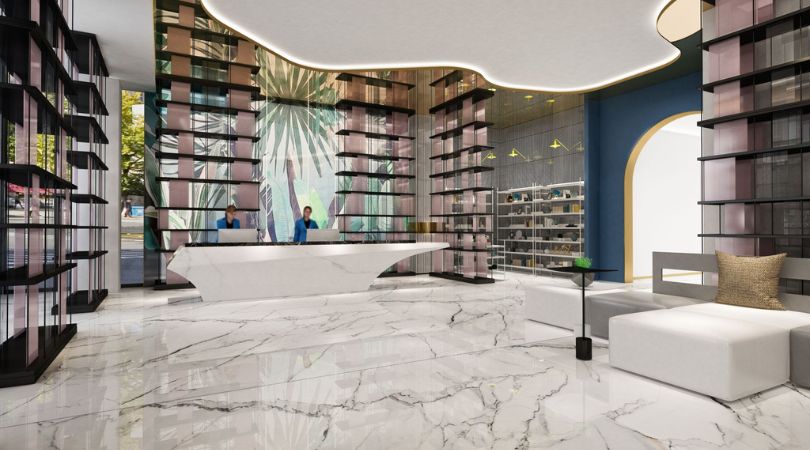
Hospitality is the hardest brief. The lobby has to photograph well, survive luggage carts, mute footsteps, and handle salty March slush all at once. What works best is large porcelain tiles at the entrances and high-traffic paths, paired with a commercial-grade vinyl through the corridors and meeting rooms. TORLYS makes a vinyl line with a sealed-joint system (called Microbloc) that handles spills better than a typical click-together laminate ever will.
The Quebec Climate Factor Most Product Brochures Skip
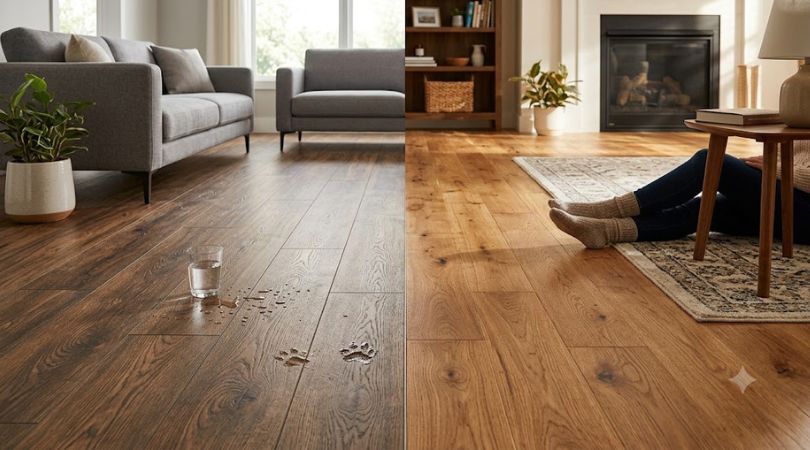
In a typical Montreal home or business, indoor humidity swings from around 60% in August to 18% in February if no humidifier is running. Floors made mostly of wood respond to that swing. They expand when it’s humid and shrink when it’s dry. A 3.25-inch solid maple plank in a retail space will likely show visible gaps by mid-January and start to cup back by April.
That’s why most commercial spaces today use engineered wood or rigid-core vinyl. Both stay flat across the seasons. About 35% of our commercial installs were solid hardwood in 2008. Today that number is under 8%, and the change tracks directly with what we’ve learned about how Quebec winters move floors around.
The National Wood Flooring Association recommends keeping any space with wood floors between 30 and 50% humidity year-round. A commercial space without a humidifier rarely holds that range through a Saint-Jerome winter, and the floor pays the price.
“Most commercial flooring complaints I see in February aren’t about the product. They’re about humidity nobody was watching,” says Sefi Dollinger, Owner of Planchers Bellefeuille, serving Quebec homeowners and businesses since 1983. “A $40 humidity meter and a properly sized humidifier solve more callbacks than any warranty claim.”
How Long Will My Space Be Closed During Install?
Realistic timelines for a 3,000 sq ft commercial space, assuming the floor underneath is in good shape:
- Carpet tile (glued down): 2 to 3 days, open the same evening.
- Floating luxury vinyl: 3 to 4 days, open the same evening.
- Glue-down vinyl tile: 4 to 5 days, plus a day before heavy traffic.
- Porcelain tile: 7 to 10 days, plus a couple of days for grout to set.
- Engineered hardwood (glued): 4 to 6 days, plus three days before furniture goes back.
For most businesses, the cost of being closed is bigger than the cost of the floor itself. A boutique shut for an extra weekend can lose more revenue than the price difference between two products. When the building allows it, we sequence commercial jobs in phases so the space can stay partly open.
What It Really Costs Over 15 Years
A commercial-grade luxury vinyl at $4.50/sq ft installed looks expensive next to a builder-grade laminate at $2.80/sq ft installed. Run the math across 15 years, though, and the laminate will likely need replacing twice, while the vinyl runs once. Total spend works out to about $8.40/sq ft for the laminate versus $6.75/sq ft for the vinyl, and the second laminate replacement forces another closure on top of it.
If you plan to keep your space more than five years, the rule of thumb is to spec one quality level above what your initial budget suggests. The longer time horizon almost always justifies the extra.
FAQs
What’s the Most Durable Commercial Flooring for Quebec Winters?
Porcelain tile and rigid-core luxury vinyl handle our freeze-thaw cycles best. Both stay flat through the seasons, shrug off salt, and tolerate the moisture that comes through the front door.
How Thick Should the Protective Top Layer Be on Commercial Vinyl?
For a moderate-traffic business, look for a vinyl with a 20-mil wear layer. For heavy traffic like retail and restaurants, 28 mil or higher. Light-traffic offices can sometimes work with 12 mil, but only if fewer than 100 people use the space daily.
Is Engineered Hardwood Acceptable in Commercial Spaces?
Yes, for light commercial use like boutiques and private offices, provided you keep the wood with a thick top veneer (at least 4 mm) and the space stays between 30 and 50% humidity year-round. Solid hardwood is rarely recommended for new commercial installs in Quebec anymore.
How Long Does Commercial Flooring Really Last?
With proper care: porcelain tile 30 years and up, commercial luxury vinyl 15 to 20 years, commercial carpet tile 8 to 12 years, and engineered hardwood 12 to 20 years before it needs a refresh.
Do You Need to Let Flooring Sit in the Space Before Installation?
Yes. Wood and wood-based products need 48 to 72 hours in the heated space before they go down. Skipping that step is the single most common cause of joint failures in Quebec.
Ready to Pick the Right Floor for Your Space?
Bring your floor plan, a few photos of what’s there now, and a rough sense of how many people use the space each day to our Saint-Jerome showroom. We’ll walk through samples under the same kind of lighting your space will have, and we visit commercial sites across the Laurentians and Greater Montreal at no charge.
Planchers Bellefeuille | 450, boul. Roland-Godard, Saint-Jerome, QC | (450) 431-1643