Planchers Bellefeuille — Flooring, Stairs & Millwork Specialists in Quebec
Most renovation conversations start with the obvious: flooring, paint, countertops. Millwork rarely makes the opening agenda — and yet it’s often the element that separates a room that looks professionally designed from one that looks like a renovation project.
At Planchers Bellefeuille, we see it constantly: a client installs beautiful hardwood floors and is happy with the result, but the room still feels like something is missing. Then we add coordinated baseboards, properly scaled door casings, and a crown moulding profile that fits the ceiling height — and suddenly the whole space clicks into place. That’s what millwork does.
If you’ve been wondering what millwork actually is, why it matters, and how it connects to your flooring and staircase decisions, this guide breaks it down clearly.
1. What Is Millwork?
Millwork refers to wood or wood-based building components that are manufactured in a mill and used as interior finishing elements. These are the architectural details — functional, decorative, or both — that give a room structure, character, and completeness.
The word “millwork” comes from the production process: these elements are precision-cut and profiled in a manufacturing facility (historically a mill), then installed on-site. The category is broad, covering everything from a simple baseboard to an elaborate built-in bookcase.
Think of millwork as the connective tissue of interior design. It ties together floors, walls, ceilings, and openings — transforming a collection of surfaces into a cohesive space.
2. Common Types of Millwork
Millwork appears in nearly every room of a well-finished home, often in ways you notice without consciously identifying. The most common categories include:
Trim and Moulding
- Baseboards: the transition between floor and wall; scale and profile matter enormously
- Crown moulding: transitions between wall and ceiling; historically associated with formal spaces but increasingly used in modern designs
- Chair rail: horizontal trim at approximately chair-back height; traditional in dining rooms
- Picture rail: functional and decorative trim near the ceiling
Casing and Surrounds
- Door casings: the trim framing every door opening
- Window casings: same principle applied to windows; often includes a stool and apron at the bottom
- Fireplace surrounds and mantels: millwork’s most architecturally prominent application
Paneling and Feature Walls
- Wainscoting: panel treatment on the lower portion of walls; classic in dining rooms and hallways
- Board-and-batten: vertical strips creating shadow lines; popular in contemporary farmhouse design
- Full wall paneling: can be flat (modern) or raised-panel (traditional)
Built-ins and Cabinetry
- Custom shelving and bookcases
- Window seats with storage
- Mudroom benches and lockers
- Media units and entertainment walls
Stair Components
- Stringers, risers, and treads
- Handrails and newel posts
- Balusters and balustrades
- Decorative panels along stairwell walls
The stair components category connects directly to the flooring and custom staircase work we do at Planchers Bellefeuille. When the oak in your treads matches the oak in your floors and the oak in your baseboards, the result is a home that feels intentionally designed from floor to ceiling.
3. Millwork’s Role in Residential Interiors
In a home, millwork functions on two levels simultaneously: practical and aesthetic.
Defining Architectural Style
The profile of a baseboard — whether it’s a simple 3/4” square edge or a layered three-piece assembly with ogee profile — tells you something about the design intent of the room. Sleek, minimal trim reads as modern or Scandinavian. Built-up, detailed mouldings read as traditional or French Colonial. The right millwork reinforces your design language; the wrong millwork contradicts it.
This is why cookie-cutter renovations that install basic builder-grade trim in a high-end home always look slightly off. The trim is functional, but it doesn’t match the ambition of the rest of the space.
Completing the Transition Between Materials
Every flooring installation ends at a wall, a doorway, or a transition to another material. Millwork is what makes those endings look intentional. A baseboard covers the gap between the flooring and the drywall. A threshold covers the transition between two floor types. A door casing defines the opening. Without these elements, every junction looks unfinished.
Adding Storage and Function
Custom built-ins are one of the most valuable millwork applications in modern homes. A built-in bookcase flanking a fireplace. A window seat with drawers below. A mudroom wall system with hooks, cubbies, and a bench. These elements add meaningful storage and function while being integral to the architecture of the room — unlike freestanding furniture, which can be moved but also looks like it could be.
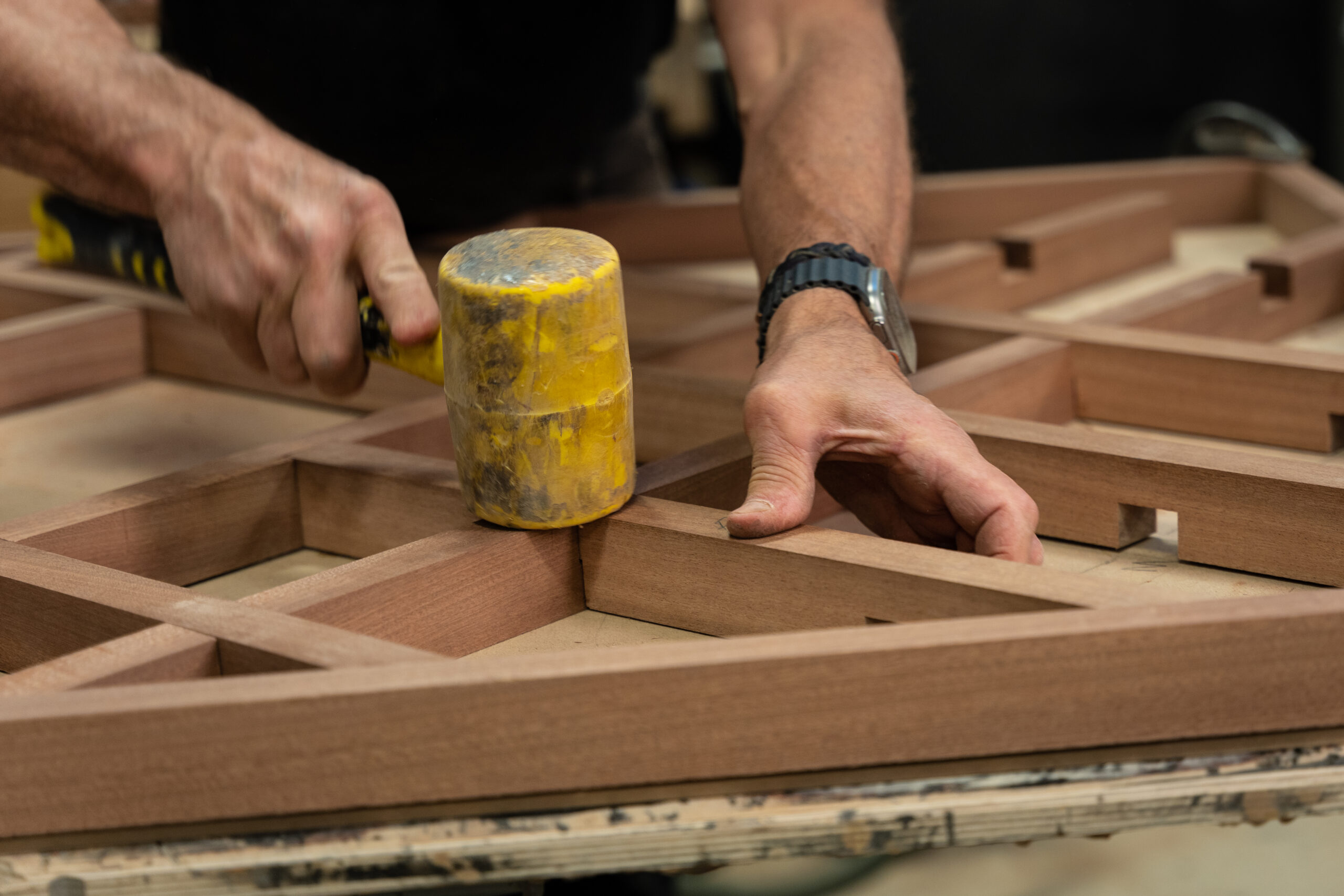
“We manufacture our own millwork components on-site, which means we can match profiles, species, and stain colours exactly to what’s already in the home. When a client’s baseboards match their stair treads match their door casings, you can feel the difference in the room even if you can’t immediately name what you’re looking at. That continuity is what makes a renovation feel like a design rather than a collection of updates.”
— Sefi Dollinger, Owner, Planchers Bellefeuille | Planchers Bellefeuille, Saint-Jérôme, QC
4. Millwork in Commercial Spaces
The same principles apply in commercial settings, but the stakes are often higher because the millwork is part of the customer or visitor experience.
- A reception desk with custom wood paneling and integrated lighting creates a brand impression within seconds of entering a space.
- Custom shelving and display fixtures in a boutique are designed to showcase merchandise in a way that’s consistent with the brand’s aesthetic.
- Decorative wall paneling in a restaurant contributes to the acoustic character of the space (wood absorbs sound) while creating warmth and visual texture.
In commercial environments, millwork also needs to meet durability standards that go beyond residential use. Materials, joinery methods, and finishes are selected with heavy traffic in mind.
5. Custom Millwork vs. Stock Millwork
When planning a renovation, you’ll typically choose between stock millwork (pre-manufactured in standard profiles and sizes) and custom millwork (designed and produced for your specific space).
Stock Millwork
- Available immediately from lumber yards and building supply stores
- More affordable upfront
- Standard profiles that work in many applications
- Limited in terms of size, profile, and material options
Stock millwork is the right choice for many renovations, particularly when the design is straightforward, the dimensions are standard, and budget is a priority. The quality ranges from basic to quite good — the difference is mostly in the detail complexity and material.
Custom Millwork
- Designed specifically for your space, ceiling height, and design intent
- Any profile, size, material, and finish is possible
- Perfect fit for non-standard dimensions or architectural features
- Higher upfront investment, with significantly better visual results
A practical example: a home with 10-foot ceilings will look best with taller baseboards and a more substantial crown moulding than a home with 8-foot ceilings. Stock trim sized for standard ceilings will look undersized in a taller space. Custom millwork solves this by adjusting scale to match the room.
6. How Millwork Works With Flooring and Stairs
At Planchers Bellefeuille, we take an integrated approach to flooring, stairs, and millwork because the three are visually inseparable in a finished space. This is something many homeowners don’t fully consider until the renovation is done and something feels off.
Coordinated Transitions
Baseboards and transition trims create the visual ending for every flooring installation. A floor with no baseboard — or the wrong baseboard — looks unfinished regardless of quality. The right baseboard completes the floor.
Staircase Integration
The staircase relies almost entirely on millwork: treads, risers, stringers, handrails, newel posts, and balusters are all milled components. When the wood species, stain colour, and finish of your staircase millwork matches your floor and your door casings, the visual continuity is powerful. The home looks like it was designed all at once rather than assembled piecemeal.
Framing the Space
Millwork frames flooring the way a picture frame enhances a painting. A quality floor in a room with no moulding looks raw. The same floor in a room with properly scaled baseboards and coordinated trim looks curated. The millwork doesn’t compete with the floor; it elevates it.
7. The Long-Term Value of Quality Millwork
Unlike paint colours, furniture arrangements, or lighting fixtures, well-designed millwork becomes part of the permanent architecture of your home. It doesn’t go out of style. It doesn’t get replaced in a refresh. It’s there for the life of the building.
From a real estate perspective, custom millwork is one of the details buyers and appraisers notice. A home with authentic built-ins, properly scaled crown moulding, and coordinated wood detailing throughout reads as a quality property — and typically commands a premium.
Quality craftsmanship also means fewer problems over time. Tight joints don’t open. Properly fastened trim doesn’t loosen. Correctly finished wood doesn’t check or peel prematurely. The upfront investment in quality millwork pays dividends every year for decades.
So what is millwork, really? It’s the architectural detail that separates rooms that feel finished from those that feel assembled. It’s the element that ties your floors to your walls, your stairs to your ceilings, your design intent to the physical reality of your space.
📌 Ready to Take the Next Step?
Considering a renovation that includes flooring, a staircase, or architectural millwork? The team at Planchers Bellefeuille can help you design a coordinated approach that ties all three elements together seamlessly.
Visit our Saint-Jérôme showroom to explore our millwork options, or book a design consultation with our specialists.
📍 450, boul. Roland-Godard, Saint-Jérôme, QC | 📞 (450) 431-1643 | 🌐 planchersbellefeuille.com
Planchers Bellefeuille offers integrated flooring, custom staircase, and millwork solutions for residential and commercial clients in Quebec. A family-owned division of DZD Hardwood Inc. since 1983. Our team brings over 40 years of craftsmanship and design expertise to every project.